Jono proudly recounts the years that it took for his life to travel ‘full circle’ right back to where he started; dreams of being an elite athlete. As Jono says, finding our passion and then putting our every hard effort into making it happen, despite what others might say, is the only way to achieve our goals…
My name is Jonathan Goerlach, dob 07/11/1982 currently 37 years old and I was born in a town called Nowra on the south coast of new south wales, which is about 2 and a half hours south of Sydney. I have 4 siblings and was raised by a single mum. My mum Is Marianne, my elder brother is Ben, elder sister Katy and two younger sisters are Erin and Stephanie.
I’ve had hearing impairment my whole life. I was diagnosed at about aged 3 and shortly after that I started wearing hearing aids. So for the first probably third of my life I was the hearing impaired kid and wore hearing aids all throughout primary school and some of high school. High school was pretty brutal – I was seen as the different kid because I wore hearing aids. I was singled out and bullied quite a bit early on and that led to me choosing not to wear hearing aids for much of high school just because I was seen as different. That then meant I missed out a lot in class, didn’t hear what the teachers were saying but the bullying didn’t stop, I was always seen as different.
I was also very passionate about sport from a very early age, as far back as I can remember. My dad was always into sport and my grandad. I didn’t have a relationship with my dad – my parents broke up when I was about four – so my grandad, Alan, he was pretty much my father figure (until he passed away in November last year) he was my best mate as well and he was very passionate about sport, and I learnt a lot about sport through him. So all through School I was passionate about all sports, and was quite good at a lot of them too, with a natural talent. Sport, especially through high school, was the one escape that I had from bullying and from feeling different.
I started playing tennis from about aged 8 and I played that religiously for about 10 years. So amongst all the sports I played were my passion and that was what I was really good at. If I wasn’t on a tennis court I was up at the school which was across the road from the house I grew up in, and I’d be up there for hours hitting the ball against the wall, or up at my grandparents’ house doing the same thing. Once the school bell rang I would head straight to the Tennis Court and have my racket with me all day at school and head straight to training. It was one escape. It was my passion it gave me a focus it gave me a lot of drive; I was treated as an equal rather than being a hearing impaired kid or being the different kid, it was a place I was treated with respect for my ability rather than having a disability.
About aged 15, I had a visit from an aunty (my dad’s sister) whom I hadn’t seen for years. She came over with my cousins for a visit and I remember her vision wasn’t very good, I didn’t understand what that was at the time. Mum tells me they were having a cup of tea and she was telling stories about me running into things or not being able to find things. I’d had my eyes tested a few years earlier but the optometrist had told me it wasn’t anything to worry about, but my aunty who knew that I was also hearing impaired suggested to my mum that maybe I needed to get tested for this condition called Usher Syndrome, which is the condition that my aunty had been diagnosed with only a few years earlier. She was also hearing impaired and she found out that she had the vision impairment side of things too, with the RP (Retinitis Pigmentosa). So that visit from my aunty prompted my mum to take me down to a local optometrist and they had the facilities to do the peripheral field testing and even twenty years on I still remember everything about that appointment.
I remember waiting beforehand to go in. The optometrist was in the local shopping centre where my mum had worked for many years prior to that. The shopping centre had shut down and we were the last appointment to go in. We went in and had the field test done, my grandad was there with me, and I still vividly remember afterwards in the waiting room when the optometrist brought out the results and spoke to my mum and my grandad and showed me the results and showed us the spherical graph that we all know too well about having RP, with the black circle on the outside and the white in the middle which is all you can see with your peripheral vision, and seeing my mum being upset. I knew something wasn’t right.
At that stage it wasn’t confirmed as Usher Syndrome, until I saw a geneticist a couple of weeks later. They confirmed that I had Usher Syndrome. The Optometrist explained that I may go blind one day and as a 15 year old kid who still had some vision that was confusing. But to know what being blind meant it made me feel a bit numb at the time, and I didn’t know what to expect – but of all the things you might think, all the questions that you would ask that told you would potentially be blind one day – they weren’t questions like ‘Am I going to be able to have a proper job?’ ‘Am I going to be able to have a wife and raise children?’ ‘Am I going to be all the normal things that people do?’ The only question I had for my optometrist was ‘Am I going to be able to play tennis?’ I was so passionate about tennis and about sport and that was all I cared about at that age.
That was what gave me my identity. That was my purpose, so when I got told I wasn’t going to be able to see my first thought was that I wasn’t going to be able to play tennis. So that was a bit of a shock.
From that point on I didn’t really tell anyone about it; it was only my family that knew. So for the last few years of high school I pretty much flopped; I wasn’t engaged in it. I still did everything to do with sport. I still played sport. But I got to a point, where I was 18, and I got sick of paying sport, because I couldn’t compete with everyone anymore.
It wasn’t a level playing field. My vision was getting worse. I learnt that my night vision was an issue with RP and that training at nighttime with tennis or ARF (Australian Rules Football) was all too difficult. I gave up playing sport and gave up my passion.
My older brother and sister were living and working in Sydney – so I decided to move up there and try something new. I moved up there and had to learn to live with being legally blind. Back in 1998 the internet was still pretty new at that stage; it hadn’t been about that long. There was definitely no social media- no smart phones – or any of that. There were no support networks. I wasn’t getting any professional support from anyone who knew what to expect or from anyone who knew what it was like to live with a degenerative vision impairment I didn’t know anyone with the condition apart from my aunty (but we weren’t really in contact at that stage). I didn’t know anyone else who had the same vision impairment let alone the Usher Syndrome, I didn’t have anyone to talk to. I was alone and I was the only person I knew with this syndrome so I ended up just keeping it to myself and just trying to deal with it.
I had no support – I was alone in the world and I felt as though I had no choice but to just bottle it up, push it down and go on with things as if I was still okay. So for several years, living in Sydney, going from job to job looking back on it I was in denial. I spent many years not talking about it and not dealing with it. Not doing anything to prepare for a life with a disability, or even accepting that I had a disability – so that meant that there was ongoing trauma under the surface there, with me not dealing with this problem that was continuing to grow.
Through those years (between 18/19 years old and 25/26) I had no identity because I had no purpose. I wasn’t playing sport because I wasn’t studying or doing anything that I was passionate about. I was just trying to fit in to society and fit in with my social groups. I was out partying every weekend, taking recreational drugs just being a single young person, travelling a lot and going overseas, and partying overseas and still getting cultured and seeing different parts of the world but I was just trying to do what all the young people were trying to do at that age and trying to fit in and not be seen as different as I was in high school.
I had a real big reality check at about age 26/27. My GP had been hassling me to prepare for the fact that my vision was probably getting worse and that I needed to prepare for life potentially being blind one day. I hadn’t been doing that and he could see that. And he urged me to go and get my eyes tested again.
At that stage it had been almost ten years roughly since I had had my eyes tested and so sure enough I got a referral and it was out of one of the Hospitals in Sydney. That was in itself a traumatic day. It was two hours travel to this hospital, where there was an ophthalmologist. And it was a six hour process from when I got there; getting the eye drops, getting all the nurses to do all their checks first and then sitting in the waiting room for another hour and a half with dozens of older people who were getting their eyes checked. It was a really depressing environment to be in. Eventually when it was my turn to see the ophthalmologist I had about 5 minutes with him and all he told me was, ‘Oh yeah, you have Retinal Pigmentosa and this is how bad your eyesight is now.’
There was no advice, no information; I asked if there was any cure or anything like that happening and he said, ‘No, nothing like that happening. Maybe in 10 years.’ And that was it, I was just left with the reality and this updated information which told me that my eyes were getting a lot worse and that I was well on the way to being blind one day, and that was it. I had travel two hours back home and stupidly I did all that on my own. Even though I had family offer to go with me that day, I didn’t take them up on that. I was too stubborn and again this was part of that process of denying it and not wanting it to be a problem. My GP was right, I hadn’t prepared for it and I was still trying to process what it all meant, and what it meant for me. At that time I went into a downward spiral.
I still remember my first anxiety attack sitting with a big group of friends. It was after a big night out and we were all sitting in a café having breakfast and it just hit me. I don’t know why, I don’t know what caused it. I just had this overwhelming negative feeling come over me and I started to panic and get the sweats. I just literally stood up and walked out. I didn’t even say anything to anyone, which was probably weird to everyone. I just walked out of the café and raced home and locked myself in my room. It was horrible.
That happened more times but that was my first experience of mental health issues. I didn’t know what it was. It was all new and I think that came off the back of being a bit depressed and not knowing that I was depressed. It took me about six months of not hanging out with my mates, and not being the same person that I was – until my mum noticed what was going on and said I needed to go and see someone.
My same GP referred me to a psychologist, the same one I’m seeing now. I’ve been seeing her for 12 years now and she’s amazing. I’m so glad that I have been able to work with someone on my mental distress. That was the very starting point of changing my life around. I had to learn what mental distress was and I had to learn that I could regain charge of my life and set myself on the right course. Being a visibly impaired person your family and friends are very protective over you and quite often can shelter you too much. I allowed that behaviour to the point where there were things like when I was 21 I said that I would like to go and live overseas and they said that would be too hard for me and that I wouldn’t be able to get a job. I believed all that, and that was an example of times that people would make decisions for me and I didn’t have the confidence or courage to say ‘No. I can do this.’ because I didn’t know if I could.
With the psychologist I learnt to reclaim my independence and make decisions for myself. For example when I was 4 years old I nearly drowned in my dad’s backyard pool and that traumatic experience meant that for the next nearly 24 years I never went near water. I never learnt to swim. I didn’t participate in carnivals at school. I missed out on many events and opportunities with friends and family over the years because I avoided water.
One of the things I challenged myself to do was to learn to swim. As a 27 year old I attended swimming classes and I learnt to go and find things that I enjoyed again. I had spent so many years doing things to fit in with other people but I wasn’t doing anything for myself. And one of those things was to start playing sport again.
My eyesight was definitely a lot worse than when I stopped playing sport. I needed to go and do something I enjoyed and that I loved. It wasn’t tennis; I wasn’t ready to go and do that. I hadn’t picked a racquet up in years, because it scared me to think I wouldn’t be able to play tennis like I used to.
I was living in Sydney and I had always been interested in rowing. I joined a rowing club. That was the first sport that I played and I did that for about 18 months and I really enjoyed that. This was at the same time that I was learning to swim. So interestingly I am learning to swim but I’m out on a boat. Most of our training would be at 5am so we would go out on the water in the early hours when the water was flattest and smoothest which was also when it was pitch black for at least the first half, if not most of the training session. So you know you’re out on the water, you can’t swim you’re nervous as hell and you’re learning this new technique which is quite technical and hard and it was pitch black and I couldn’t see anything. So that was throwing myself in at the deep end but without jumping in the water which we didn’t want to do. Then one of the other challenges I set myself was going overseas and living in another country which is something I was told I wasn’t capable of, so I saved my money and spent a year working it all out.
I got my visa for the Netherlands and booked a one way ticket. I didn’t book a return flight and I just said; ‘I’m going’. Aged 28 I moved to Europe. I travelled for a few months through Europe. I’d been to Europe a few times before and I had quite a lot of friends over there. So I went and visited a lot of friends. Before arriving in Amsterdam I went to the Lake District in Northern England and met with about six other people of a similar age at the time who also had RP. And that was the first time in my life that I had met anyone with RP let alone anyone of a similar age who I could relate to. That was a very significant moment in my life to have that opportunity to share my story with others who all had very similar stories and just spend three or four days just hanging out and having a beer and spending time with each other and just essentially knowing that we weren’t alone. One of the people who was at that event was Yvette, that’s how we became friends and we’re still friends today. That in itself was a really life changing moment.
I did end up in Amsterdam, and ended up living there for about 18 months. And again that new found confidence and attitude that I had created at home before I left, was taking risks and trying new things, taking on opportunities and not thinking so much about what would it mean if I did it.
I hadn’t ridden a bike since high school/ it was over ten years since I had ridden a bike it was one of those things I couldn’t do. And I spent over two thirds of my time in Amsterdam riding a bike, riding to work and riding all over the city. It was amazing, something so simple as a vision impaired person you were told you couldn’t do. I was able to reclaim my independence. I was over there on my own, I had a couple of close mates from Australia that were living over there too, it was really good to have them there. They helped me out at different times, especially when I first got there. I stayed on my mate’s couch for the first couple of months whilst I found myself a job and somewhere to live and got myself set up. So I had support there but essentially I was there on my own to meet new people and try new things. And that was a real pivotal moment in my life that set me on this path that I find myself on now.
It was around 18 months I was there and it was around 2011 just before I turned 30 I decided to move back to Australia. Apart from the visa ending the main reason to move home was because when I was living in Amsterdam I didn’t continue with my rowing. I did get back into my running, and I joined the athletics club there and whilst I did that I came across an article on the internet about the Paralympic games, I was here in 2011 and a year later the London 2012 games would be held. So I thought maybe I should see if I was eligible to compete in the Paralympic games. It was the first time I had actually even thought about it. I didn’t think my eyesight would be bad enough to be eligible to be classified to compete in para sports.
So I contacted my national Paralympic committee back home and sent them my latest visual results and they said that I was eligible. I didn’t have enough time to prepare for London; I needed several years to train in any sport really let alone running. But I had seen a press release saying that Triathlon had been accepted into the Paralympics, in Rio 2016. And it was the first time Triathlon had been accepted in the games.
I had loved watching Triathlon as a kid, although I couldn’t swim and avoided the water as a kid I really appreciated how fit they were. So that was it. I said, ‘okay, it’s 2011. I’ve got 5 years to train and see if I can do this and achieve this goal of becoming an elite athlete. Go to a Paralympic games. And within that a side goal of learning to swim properly and learning to swim fast. My life changed from that moment when I set myself that goal.
At aged 30 I went home and went back to Nowra. I lived with family for a couple of years and lived in a supportive environment. Not only supportive of just me being a person but also supporting my triathlon training and encouraging me to pursue that. I lived in Nowra for two years until the point where I realised that I needed to move to be coached by a proper triathlon coach, to be in a Triathlon squad and be trained with other people. So I moved to Canberra, which is the capital city of Australia. It’s about a two and a half hour drive from Nowra. I got myself a job there.
In 2007 I qualified as a remedial and sports massage therapist, while I lived in Amsterdam I worked as a massage therapist, so naturally when I moved to Canberra to keep working I continued my massage work and I also did something I never thought I would do which was to enrol in University as a mature student. I flopped High School and had really poor grades and never thought that I would go to University. I had teachers tell me that I was not smart enough for certain classes and basically told me I would never be good at anything.
Not only training to become an athlete and qualify for a Paralympic games I’d signed up to do a degree, a bachelor in sports management and fast forwarding a bit I ended up taking five years of part time study to complete that degree and I graduated at the start of 2019. I lived in Canberra, I loved living there. I trained and gradually learnt to train like an Olympic athlete and I learnt to swim and throughout that time I was competing all over the world. Triathlon was quite new in the para world but developing quite quickly, so there were lots of new athletes coming into the sport and lots of athletes coming in from other sports to compete too, so the sport was growing and the competition was getting stronger very quickly.
In 2015 I had a major setback, those of you who know para-sports or Paralympic sports know that there are several disability types in a sport and because of that it is impossible to have a medal event at a Paralympic games for every single disability type in every single sport. So there is a quota on the amount of sports and then within each sport there is a quota of medal events that that sport will have that they need to choose to disperse amongst the games categories. So unfortunately for me for our sport we were given a quota of 3 medal events per gender and at the time we had five different disability categories in our sport, so two categories had to miss out.
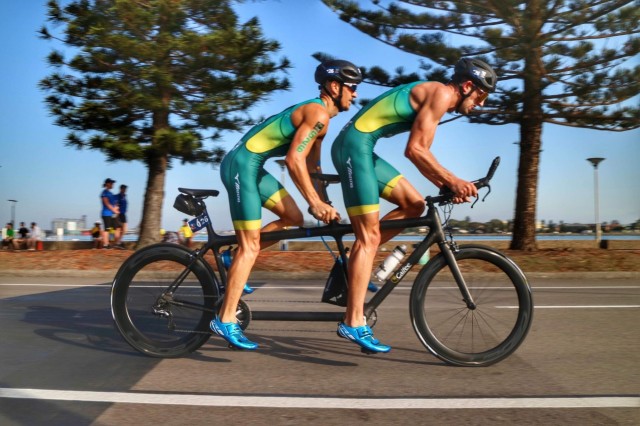
We were told that I didn’t have a medal event, and that was a huge set back, not only that I wasn’t going to have the opportunity to go to Rio but also for funding. I was being funded by my national federation and it is an expensive sport, when you’re travelling all over the world especially when you have to race with a guide. In triathlon I need to race with a sighted guide. We swim together, ride a tandem bike and we run together too. So I needed to cover their costs also. Having no Rio event meant that I no longer received funding support because I was no longer on a pathway to the games. So the next couple of years were really, really tough and I wasn’t sure I was going to stay in the sport. I was shattered that I couldn’t achieve the goal that I had set out to achieve and I wasn’t sure if I was going to continue onto the Tokyo 2020 Paralympic games; it was a long way away and the sport was going to continue getting better and more competitive. Also I didn’t know if I was going to be good enough, and I didn’t know if I could continue to afford to pay for two people to keep travelling all over the world to keep racing and gaining ranking points as it is just a big process.
But I just decided to take the risk and stick with my passion. That was advice that was given to me very early on back in 2012 when I took part in an Australian Paralympic Committee talent search day. When I got back from Amsterdam I went and did that to see if I had good ability in any sport. The advice I was given that day was whichever sport you decide to go with make sure it is one you are passionate about, because if you pick a sport that is an easier way to get into a Paralympic games that you aren’t passionate about you aren’t going to enjoy the training. That advice had stuck with me. I loved it and I had come so far with it, and invested so much time. It had changed my life; I had so many great opportunities come from just being in the sport. I met some amazing people, the prime minister at the time, I met prince Harry and went to many big events and did public speaking and met sponsors. My life had changed and I wanted to continue on in that sport.
Once Rio was approaching I needed a change. I needed a change in environment and a change of coach, so I moved to Melbourne. That was at the end of 2015, start of 2016 and I continued working, training and racing all over the world and racing with several different guides and a new coach. I just really enjoyed my time in Melbourne and learnt a lot more about life and had relationships. But I was still learning more about my disability and the disability world. When I got into triathlon, over the years, I found my voice and decided that I had a lot to share and I felt like I had a lot to say. I felt that I could help people through talking about all my previous life experiences and the the process I’d been through to accept my disability. To state that I had a disability and to be proud of it, and that I was part of a family. I was part of the Paralympic movement. I was a part of things that were bigger than me which I didn’t have before; I had found identity and purpose through sport.
I lived in Melbourne for around three and a half years and then I was having results in triathlon. I was getting better and better. We’d have a world championship every year and every year I was getting closer and closer to the top guys, to the bench mark athletes that were always at the top, and that kept driving me to keep improving.
In 2018 I won a really big race over in Edmonton, Canada. It was at that time it was announced the medal events that were going to be given out in triathlon in Tokyo 2020 and we had six categories of disability at that stage, and we were given 4 medal events. So even though we had four medal events we still had two categories that were missing out, but this time I was extremely fortunate to be in one of those medal events (or disability categories that had a medal event) in Tokyo, so that changed everything again.
I was being funded again by my national sporting federation. Being supported in every way possible to be the best athlete I could be and to really reach my potential. I had to move again, to an elite high performance training environment if I wanted to reach my potential, I needed to be coached by a top level coach and there weren’t any available where I was. I ended up moving to a regional town called Wollongong; which is basically half way between Nowra and Sydney where I grew up. It’s on the coast of New South Wales and in a beautiful part of the world. It was really good for me to move back there. I had spent so many years away from all my family and friends who were living back there and my siblings who were living in Sydney. To live right in-between all of that was a really big thing for me and also to be training in a really great environment and have access to all the things I needed to train at my best and have access to a really good coach.
I’ve been in Wollongong now for 18 months and I’m getting really good results. I’m ranked number 3 in the world and I’ve all but secured a spot in the Tokyo Paralympics. Fortunately in our sport to qualify for the Olympics we have a twelve month qualifying window which started in July 2019. It was supposed to go to July this year before the games were postponed. In that window your three best results are counted towards qualifying and if your three best results (or your ranking points) mean that you qualify within the top ten you will get a spot within the Paralympic games.
I’ve already got my three races done at time of writing and I’m currently ranked third in the qualifying period. Although qualifying hasn’t finished yet and the current Covid 19 crisis that we’re in means there is a big set back there in terms of the fact that we have to wait until it is safe for everyone to travel again around the world and travel to all the races and restart the qualification period again. But we know that all the races are already completed in that window count – so no matter what happens I know that I have done everything I needed to and I have pretty well qualified.
When I get the plane ticket that says you’re going to Tokyo I’ll get excited, but I still need to wait until that time for that. I am so close now. If Tokyo was this year, it would have been an 8 year journey to get here.
Now with Covid 19, it is a different world and we need to make sure everyone is safe and well and get better before we can get to the games. One extra year to the games, although it is disappointing, means the goal posts have just been shifted. It doesn’t mean the games have been taken away. For me I have already taken a setback for Rio 2016, so I’ve already taken another four years to get to this point; it’s already been eight years so for me another year I feel fine with that. It gives me another year to train and get even better than I would have been in August 2020 when the games would have been. I take the positives out of it. I’m going to continue living here in Wollongong and keep training and staying focused on being the best athlete I can be.
That takes me right up to where I am now. Some of the lessons I have learnt. Having a disability has made me more resilient despite all the things I’ve already spoken about before I accepted my disability; the mental health issues, going through that whole process of losing my identity and purpose have contributed to how I feel now. Having come out of that the other side and having learnt from that has made me a much stronger person and made me feel more empowered. I feel like I have a lot of courage in life and I feel more independent than I ever was before.
I have a lot to give back to the community. It isn’t just about my sport; it is about what my story can do to help others. When I was younger sport was the one thing that got me through life and that was the one thing that kept me healthy and focussed. I gave that up when I was about 18 years old, and it took me ten years to find my way back into sport. I feel like I have picked my life back up again from when I left it. Life has just come full circle, and sport was always the thing that was going to be the answer. I have graduated with a sports management degree. I’m working towards a career in the sports industry and sport has given me everything. I am giving back as much as I can to that community and to other communities too.
The one message I can give to people out there who are reading this is to find something you are passionate about. Life is hard whether you have a disability or not, and I think if you have something in your life, whatever it is, find something that makes you happy and something you can push yourself in. Something you can challenge yourself in, learn from, grow in and get better at, and essentially you’ll become a better person because of.
I’m sure that those that have that will understand what I am saying and those that don’t – maybe you haven’t found your passion yet. When you do you’ll know what I am talking about. It makes everything clearer and you have something to aim for.







 Reframing Mental distress as a potential catalyst for positive change