Spiritual crisis and late-stage capitalism: 4 lessons from the edge of sanity.

This article, written by my dear Soul Sister, Martha, is shared (with permission) from her website: https://transpersonal-integration.com/blog/nbspspiritual-crisis-and-late-stage-capitalism-4-lessons-from-the-edge-of-sanity

Those Martha speaks of – the individuals who have had significant breakdowns leading to a palpable transformation in their everyday lives are worth learning from, is because they hold an embodied knowing, a felt sense in their bones, of what the collective is moving through right now – are the very ones I am learning from in my current research, because their wisdom is a vital part of our evolution, and their voices, so often silenced by pathologisation and medication, need to be heard.

Written By Martha Sneyd 26/01/24

What wisdom can we gather from transformative crises in individuals to assist humanity’s urgent transition out of late-stage capitalism?
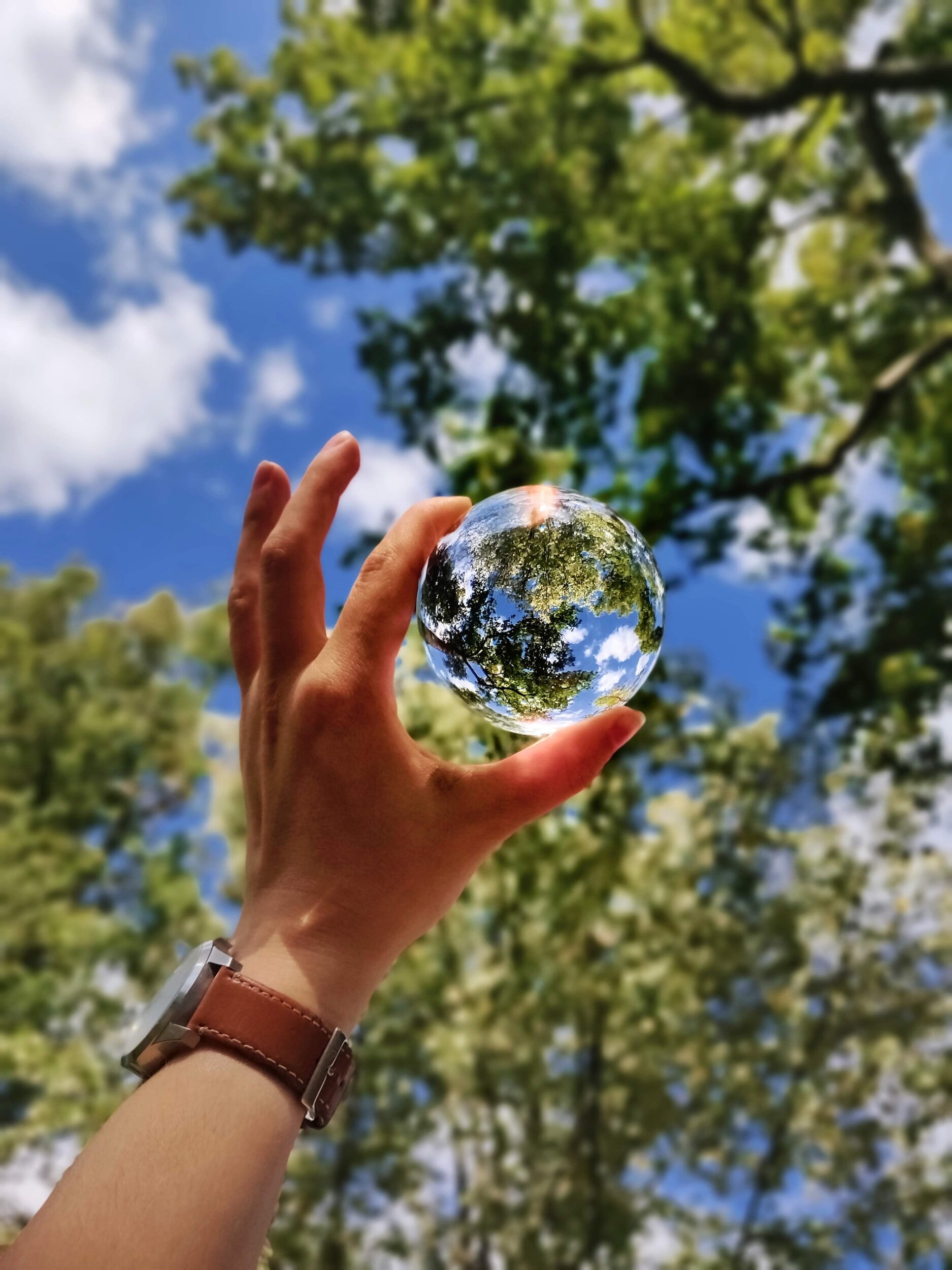
“The capitalist system has imposed on us a logic of competition, progress and limitless growth. This regime of production and consumption seeks profit without limits, separating human beings from nature and imposing a logic of domination upon nature, transforming everything into commodities… Humanity confronts a great dilemma: to continue on the path of capitalism, depredation, and death, or to choose the path of harmony with nature and respect for life.” – People’s Agreement of Cochabamba

Imagining post-capitalist realities, ways of living and being that don’t reduce the earth and human life to what can be extracted from them is an essential step in moving towards a sustainable future. I believe this requires us to accept the breakdown of our current systems and seek a way of collectively alchemizing this time of collapse, into a ‘breakthrough’. Enacting a ‘breakdown to breakthrough’ transition for planet Earth will need to be informed by inner transformation, which then translates to wise, innovative outer action and social change.  This is not a unique idea; the United Nation’s ‘Inner Development Goals’ harnesses the application of inner development and transformational skills to global challenges faced by humanity.

Going through my own transformative crisis, and having worked with countless individuals with similar journeys, it is my firm belief that there is valuable wisdom to be harnessed from those emerging from their own personal ‘breakdown to breakthrough’ experience. This is not to say that people with this experience have healed everything- there is always a shadow, a wound, a behaviour that needs attention, in all of us, forever. The reason I think that individuals who have had significant breakdowns leading to a palpable transformation in their everyday lives are worth learning from though, is because they hold an embodied knowing, a felt sense in their bones, of what the collective is moving through right now.

Slow, steady transformation over time in individuals is incredibly needed too, and no less profoud, in fact let’s admit it- it’s a lot less messy, inconvenient and challenging too. However, despite the obvious difficulties of going through an acute crisis, there is something unique about the experience of emerging from a full blown crisis feeling more whole, more connected, more clear- especially when properly integrated with consistent spiritual practice and psychological therapy if needed.  These are the ones who will have faced the void, their own death, their own delusions and their own divinity. They will have grappled with how to hold all of that, and what it means to be a human here at this time. They will have been humbled and brought to their knees a hundred times and found the strength to emerge from the rubble of their former lives, more loving and more aware.

“Maybe the journey isn’t so much about becoming anything. Maybe it’s about unbecoming everything that isn’t really you, so you can be who you were meant to be in the first place” Paul Coelho.

This is what humanity needs to do on a collective level, but instead of valuing these people, society tends to shame them because they have embodied what we are all too afraid to admit- they have embodied madness and delusion; destructive and often inappropriate behaviour. They have played the role in this cosmic drama that no one wants to play- a crystal-clear mirror to the human collective of its own deep insanity. In Western society, we consciously and unconsciously suppress the symptoms of crisis to avoid the discomfort and inconvenience of looking in this mirror. We do this to individuals through medication and incarceration, as well as on a societal level, through consuming, overworking, self-medicating and addiction to our devices.
Key Learnings from the edge of sanity

1)   Acceptance of one’s own delusions, madness, and self-destructive behaviour

A prerequisite for returning from the edge of sanity is the acceptance that we did indeed, for a time, lose our mind. The facing square on of one’s delusions and the inappropriate or destructive behaviour that may have arisen from them is what is required for long-lasting transformation to take place after a breakdown. I would assert without hesitation that humanity is in the grip of madness. In today’s world, where we continue to actively destroy the ecosystem upon which the physical sustainability of all life, including our own species, depends, only the most determined (and financially powerful) stay in complete denial of this. Capitalism relies on and thrives on the denial of our collective insanity and self destructive behaviour. It takes huge courage to admit you have been mad; it goes against every survival instinct in our bones, to risk exile from ‘the tribe’. Yet it is this neo-liberal tribalism permeating western society, that we must have the courage to exile ourselves from.

2)   Facing death/mortality

Many people who have experienced a spiritual crisis will have had an encounter with death or their own mortality. This is sometimes by mistakenly believing they have died, which impacts the body/mind profoundly despite not being true. In Dark Night of the Soul experiences, there is a deep descent into the death realms. Other times it might be through the physical risk of crisis bringing the experiencer close to actual death, including through suicide attempts. What good, if any, do these encounters with mortality and death do for the human being in today’s world?

An ongoing relationship with death is essential for embedding the human experience within the appropriate context of the earth’s ecosystem. The death process is essential in the cycles of regeneration and renewal that are inherent to life on this planet as well as to the mysterious alchemy of transformation (Ladha & Murphey, 2022) so urgently needed now. Reciprocity is central to these currents of life, death and transformation- knowing when and how to receive, and when and how to let go, in balance with the greater whole, requires deep acceptance of death. In today’s death-phobic, growth-centric society, contemplating dying and as such, leaving everything behind that capitalism needs us to grasp at, is a radical act of liberation desperately needed by humanity.

3)   Mythic images

When a spiritual crisis includes manic states, there are certain images and ideas that arise which seem to be universal to those experiencing these non-ordinary states. John Weir Perry, a psychiatrist and student of Jung studied these patterns and drew remarkable parallels between the influx of images experienced in manic states, with the myths and rituals of antiquity at times of civilizational change. Common themes include stories of creation and destruction, cosmic combat, powers of light and dark, chaos and order, and a vision of oneness expressed in messianic ideation. Through extensive research, he began to see the arising of these rich mythic images as the natural effort of the psyche to move towards a greater state of wholeness, as well as articulate a vision for a more harmonious society. Films like ‘Crazywise’ point to the valued role non-ordinary states of consciousness and those prone to them, play in traditional societies.

The fact that these visionary states are now pathologized, medicated and dismissed as useless and invalid by western medicine could correspond with the ‘crisis of meaning’ that being lost in the depths of late-stage capitalism has created. Thought leaders exploring the complexity of the current meta-crises facing humanity recognise the timeless role of myth in ushering in civilisational change. Two of these thought leaders, Ladha and Murphey (2022) put it like this: “As we expand the mytho-poetic landscape and the corresponding creation of embodied knowledge and cultures, we may avail ourselves to the direct wisdom of the Gaian entelechy and the quiet whispers of that which is beyond our perception” p.202.
 4)   Increased sense of interconnectedness and connection to the divine within.

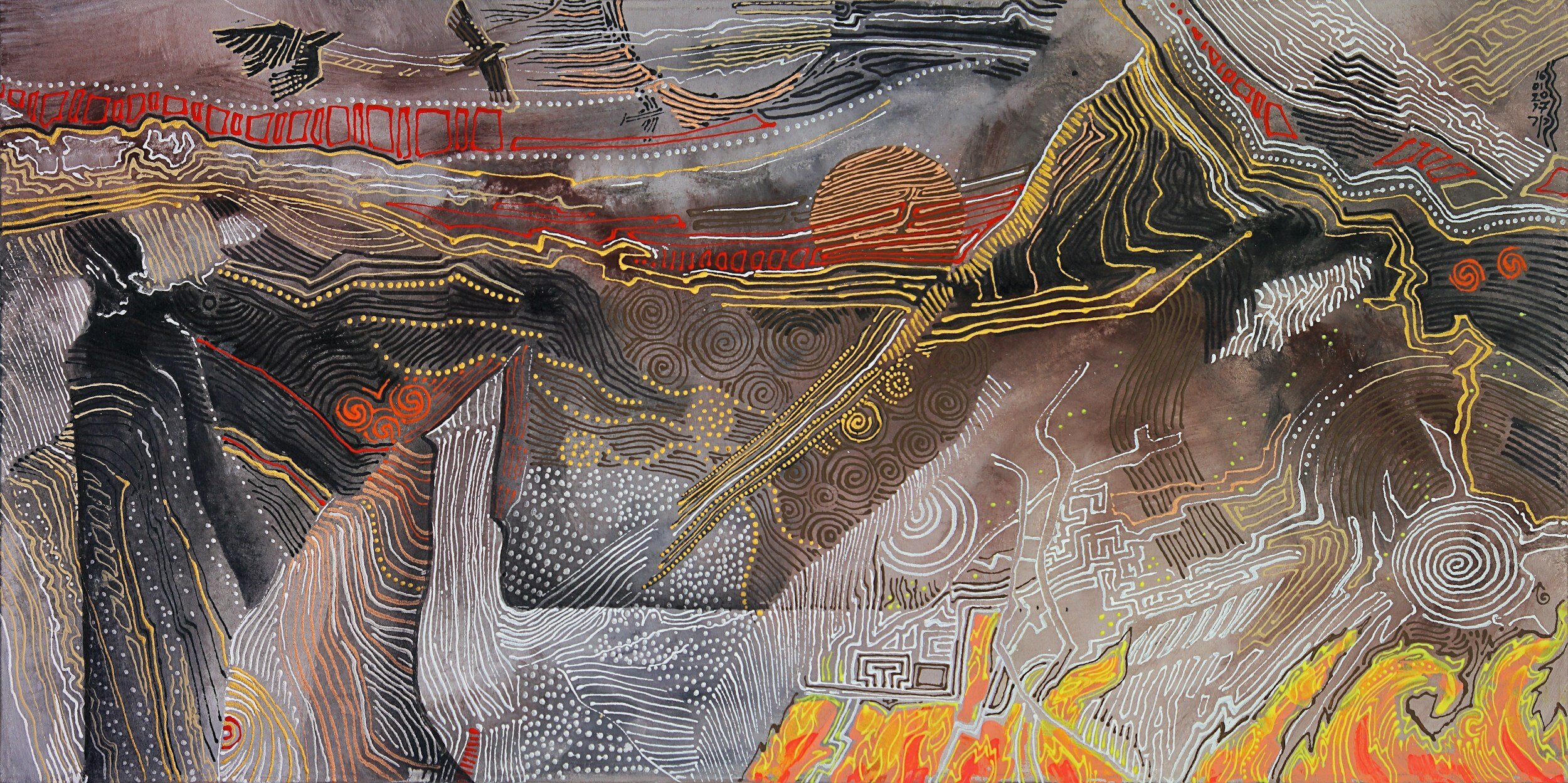
A consequence of going through a spiritual crisis can be that during as well as after the non-ordinary states occur, there is an increased sense of interconnectedness with the rest of life, including Source, Oneness etc. In normal consciousness, without spiritual practices, psychedelics or spontaneous awakenings and crises, we usually feel most connected to our own body, mind and emotions, as well as the people, activities and issues that affect our daily lives. There might be an abstract belief that we are more than this, such as a soul, but this is quite different to having a tangible felt sense and unmistakable knowing of the interconnectedness of all life and the divinity within every Being. Spiritual emergencies often include these elevated states, where the former boundary of ‘me’ and ‘mine’ becomes expanded to include the mountains, the birds, the river, the person walking their dog- everything. This can lead to a number of behaviours (not all of them wise or helpful) but most of the time there is an overwhelming sense of compassion for all of life and an urgent sincere calling to usher in a more evolved, peaceful and enlightened consciousness on planet earth. Even when the interconnectedness is experienced as paranoia, there can be profound learnings as distilled by Ricky Derisz in this illuminating piece.

The lessons we can take from the subjectively positive states of interconnectedness that tend to go hand in hand with mania and spiritual crises, is not to encourage ‘ego death’, losing our identity or our personal boundaries. The most useful learning is around how we can feel ourselves to be both ‘the ocean and the wave’- connected to All that is, to the Divine, to the more-than-human world, to our communities and to people we formally saw as ‘Other’.  And at the same time, honour ourselves as the wave, having a valid experience of individuality, and all the complexity and forgetfulness that comes with that. The emotionally numbed state of denial in which capitalism holds the majority of Western society requires a rigid and limited sense of self- an anxious, deeply paranoid wave, fearful and envious of the ocean it doesn’t know it is a part of. Fear is an exceedingly useful emotion to capitalism; it underlies much of humanity’s most destructive behaviour, including our grasping for ‘more’ which then over time becomes a perceived entitlement for more.

Final Thoughts

This piece is an exploration of how crisis in individuals relates to the meta-crisis of our times, driven predominantly by late stage capitalism. It takes an unfinished look at the way personal, inner experiences of breakdown might inform a collective breakthrough into postcapitalist realities. Through working with people emerging from spiritual crises, the themes i’ve addressed above have an archetypal nature to them, ocurring again and again in the journeys of individuals. What does this mean? And how can these archetypes serve our journey as a species towards sanity and healing? These are the questions myself and many others are contemplating at this time.

A final point I need to address is the attempt in transpersonal psychology to differentiate a ‘spiritual’ crisis from plain old madness, which in my view is missing the point- for it is not in how a crisis manifests, but in how it transforms the person over time, that makes it a spiritually regenerative experience. Of course, the capacity to transform through crisis is dependent on a variety of socio-economic factors, exacerbated by late-stage capitalism, inequality and trauma.

This is why it is important to highlight the way the capitalist system stunts the psychic process of renewal in individuals through actively increasing inequality and poverty which research has shown make incarceration and over-medication of a spiritual crisis more likely.

It seems all the more poignant then, that the wisdom gathered through the very states of consciousness that capitalism most vigorously seeks to oppress, point to its remedy and demise.

Support

If you or somebody you know is emerging from non-ordinary states of consciousness and needing a spiriutally aware, psychologically safe container to integrate the experience, feel free to reach out for a 1:1 session with me HERE.
Posted in Uncategorized | Tagged , , , , , , , , , , , , , | Leave a comment

Invitation to Participate in a Research Study: Personal Transformation and its Role in Action for Sustainability

Have you had a life-changing experience that prompts you to say “after that, nothing was the same”?


If you have had a significant and transformative shift in your life, please consider this invitation to contribute your authentic experience in adjusting to profound change.

Did you know that there is very little scientific research available to spiritual and mental health professionals about how to support the integration of spiritual emergence and personal transformation?

The first phase of my colleague Beth’s university-approved dissertation research is gathering information on practices that support the accommodation of change, and she would value your expertise in rating these practices. By participating in this online survey you will have the opportunity to learn about more than eighty recommended practices – some of which may be immediately helpful to you – and you will be able to rate the effectiveness of each one.

Your participation is important and valued because this information is important in ongoing efforts to connect transpersonal experience with the scientific rigors of mainstream psychology. Your contribution will support expanded understanding and support for people who are navigating spiritual emergence, and the people who support them.

This online survey takes about 25 minutes to complete – which certainly is a contribution of your time – but the potential benefits are significant. While it may be directly helpful to you to learn what practices others have used, your authentic experience will help to identify to the mental health community the most important practices for integrating profound personal change. Your participation will contribute to appropriate guidance and support for many others in the future.

Who can take part?

     This study is open to those who:

  • are fluent in reading and writing in English
  • are more than 18 years old
  • have had a transformative life experience as defined above at any time in the past
  • are willing to answer questionnaires related to their experience of significant life changes

     This study is not suitable for you if you are:

  • currently feeling overwhelmed or distressed by a life-changing experience
  • currently experiencing acute mental health challenges

CLICK HERE TO TAKE PART IN THE SURVEY

Thank you for your consideration, participation and support.

Full information about this research project is here – https://bethhallidayresearch.sutra.co

Should you have questions about this project, please feel free to contact the researcher at  e.c.halliday@2021.ljmu.ac.uk 

Thank you for your support and participation!    

 Beth

Posted in Uncategorized | Tagged , , , , , | Leave a comment

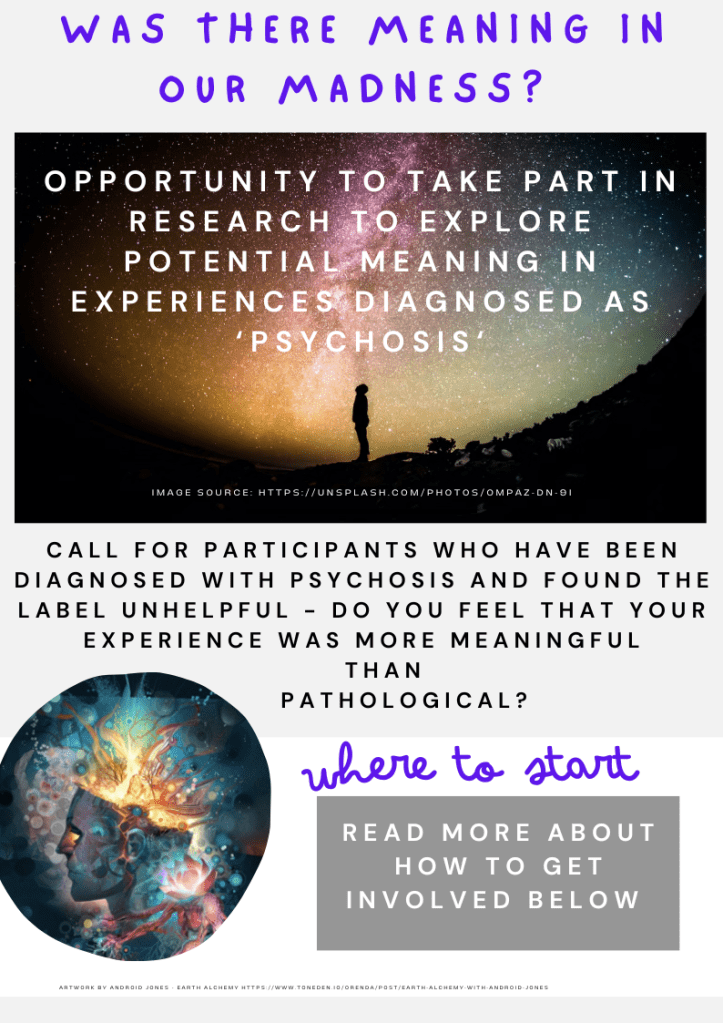
Did you find transformative meaning in your experience diagnosed as psychosis? Opportunity to take part in research

Have you ever had an extreme experience which had led to you being officially diagnosed with ‘psychosis’ by a medical professional?

You may be interested in taking part in research which seeks to explore Transformative Meaning in our ‘Madness’ – are experiences diagnosed as psychosis meaningful rather than just pathological?

The purpose of this study is to explore how some people find and harness transformative meaning in their experiences conceptualised as psychosis by clinical psychiatry in order to better understand and support them.

If you would like to share your feelings and experiences for this research study and are chosen to take part, you would be interviewed for approximately one hour via zoom.

To take part in this study, you need to fit the following criteria:

  • Have previously received an official label of psychosis by a medical professional
  • Found this label unhelpful and sought alternative ways to understand your experience.
  • Not experienced an extreme episode for at least 2 years, are currently emotionally stable / are not suffering from any serious or ongoing psychological difficulties
  • Between 25 – 75 yrs. of age  
  • Fluent English speaker
  • Able to talk about a transformative aspect of your experience and the meaning gleaned from that
  • Have access to a solid, current support network, and are able to develop a personal support plan in case this is needed during the process
  • Be willing and able to give feedback on transcripts and interpretation of your data  

There will be a formal information sheet which will explain in more detail. However, it is important to say that there is a risk the interview may trigger difficult feelings as the research is exploring such an emotive topic. To support your process, you will be given resources and signposted to services before and after the interview.

If you feel that you fit the inclusion criteria above and are happy to go ahead, you can complete this Pre-Screening Questionnaire which will be used to assess your eligibility to take part. It should only take around 10 mins to answer the questions. Please note, completing this questionnaire does not mean that you will be contacted to take part in the study.

Your responses will be kept confidential and will be used solely for research purposes.

Your participation is entirely voluntary, and you may withdraw at any time. If you are invited and choose to participate, your time and effort will be greatly appreciated and will contribute to the success of this project.

If you would like any further information regarding this study, or have any questions or concerns, you can contact the primary researcher at: K.Mottram@2021.ljmu.ac.uk or the project Supervisor: Dr Ellis Linders at ellis.linders@aleftrust.org

Posted in Uncategorized | Tagged , , , , , , | Leave a comment

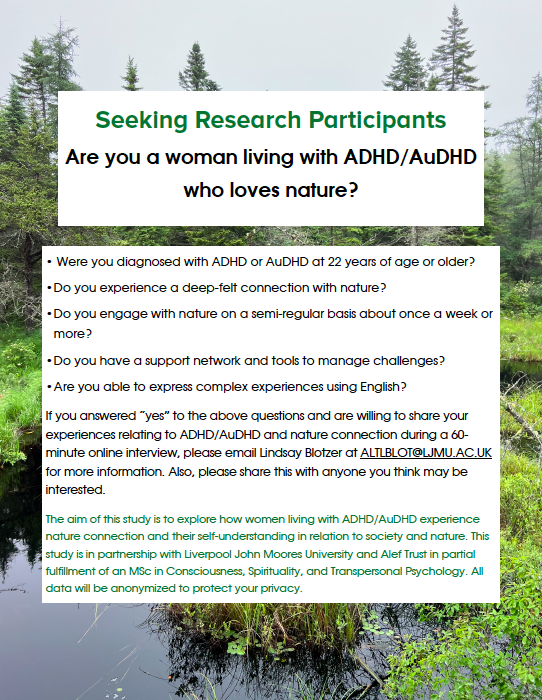
Participants Required for Research Study into Nature Connection for Women Diagnosed with Autism / ADHD

Would you like to take part in an important research study exploring how women living with a diagnosis of ADHD/Autism and ADHD experience nature connection as well as their self-understanding in relation to society and to nature? 🌞 🌊 🌸

Are you a woman living with ADHD/AuDHD who loves nature?
Were diagnosed with ADHD or AuDHD at 22 years of age or older?
Do you experience a deep-felt connection with nature?
Do you engage with nature on a semi-regular basis about once a week or more?
Do you have a support network and tools to manage challenges?
Are you able to express complex experiences using English?

If you answered “yes” to the above questions and are willing to share your experiences relating to ADHD/AuDHD and nature connection during a 60-minute online interview, please email the Researcher: Lindsay Blotzer at ALTLBLOT@LJMU.AC.UK for more information.

All data will be anonymized to protect your privacy.

This study is in partnership with Liverpool John Moores University and Alef Trust in partial fulfillment of an MSc in Consciousness, Spirituality, and Transpersonal Psychology.

With this research, Lindsay hopes to contribute toward a greater understanding of the experiences of neurodivergent women and nature connection.

Thank you ❤

Posted in Uncategorized | Leave a comment

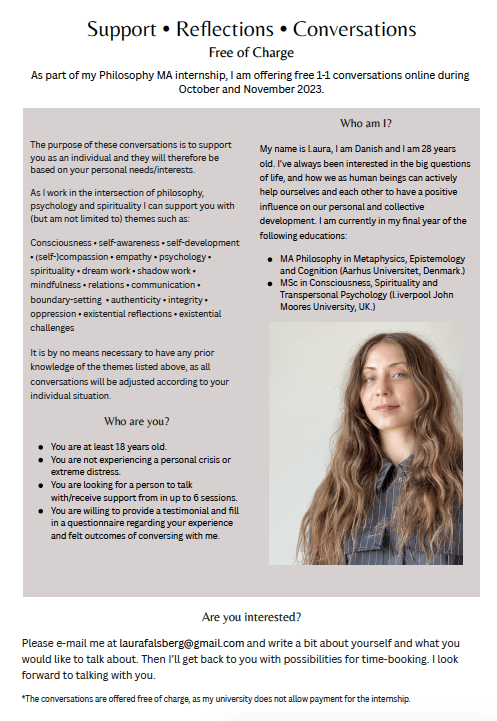
Struggling with existential questions about life? Supportive Conversations still available free of charge

My wonderfully wise and compassionate co- student on Alef’s MSc in Consciousness, Spirituality and Transpersonal Psychology, Laura, still has spaces available if you’re struggling with some bigger life questions and would like to take the opportunity for some free supportive conversations…

Laura says: The project has got off to a great start but I still have some availability for sessions, so please feel free to get in touch! Please email: laurafalsberg@gmail.com to book an initial session.

Posted in Uncategorized | 1 Comment

I’m going through a spiritual crisis. How can astrology help me? (Written By Martha Sneyd)


If you have recently experienced some kind of spiritual crisis and are looking for help understanding and integrating it, this article is for you. I will take you through how working with a trauma informed astrologer can honour the spiritual wisdom of your experience, while situating it within the bigger picture of your life, and your destiny. This can offer reassurance, grounding as well as inspiration.

My work is all about supporting people to navigate life after big, powerful experiences- experiences that we could call transpersonal -because they connect us to something beyond ourselves. It could be anything from a blissful awakening experience to a manic episode to a dark night of the soul- or all three.

So what might be the role of astrology in this process of integration and transformation?

As a practitioner and eternal student of astrology, specifically ancient western astrology, I have found it to be a powerful ally in my own process, and in the lives of friends, peers and people I support.

Here’s a little background on what I mean by ‘ancient, western astrology’ and why it can be such a profound healing tool:

In the ancient world, natal astrology (where the life of an individual is studied) emerged around 500 BCE. It was born from a time in history where a diverse variety of Mediterranean religions, Mystery Schools and philosophical ideas were blossoming, along with advances in mathematics and astronomy.

Ideas about the nature of reality, the soul, divinity and the heavens were shared by Platonic, Pythagorean, Orphic and Hermetic wisdom traditions which included astrology and the zodiac. I share this to highlight something that is perhaps obvious- practiced correctly, astrology was deeply spiritual and was discovered as a way to embody the insights of some of the ancient world’s most well-known and profound thinkers.

For the sages who practiced it, it served as a reminder of their eternal nature amidst the diverse rollercoaster of earthly experiences. My teacher, Adam Elenbaas puts it beautifully:

“Astrology trains our minds to see eternity within the fluctuations of our material lives, especially the ups and downs of our destiny path”.

With this ancient form of divination as an ally, we are able to see the diversity of experiences (including the hard ones) as part of something bigger. This perspective is probably not new to you, but what astrology offers is to see, literally written in the heavens, the archetypal signature of whatever you are grappling with: Troubles with a partner, issues with a child or a parent, a change in financial situation, or, mental, emotional or spiritual sorts of crises and transformations. Trying to remember that whatever each moment brings is part of a larger, divine picture becomes easier with astrology because it offers more detail about that picture, infusing life with meaning, depth and soulfulness in a grounded and pragmatic way.

With spiritual crisis, there can be a sense of being shaken to the core. If you’re reading this, then you know: This is not just the furniture of your life being moved around, like a new place to live, a new job or spouse.

It is like realising the life you thought you had, with all that nice furniture, doesn’t even exist in the way you thought it did.

There’s no going back from this kind of experience and your life will change. This can be both liberating and destabilising; exciting and paralysing; joyful and terrifying.

Without the right support, this is the point where some people go mad- too much has changed too quickly within the psyche. 

Reality is not what I thought. So what the hell is this? Who am I? Am I everything? Am I nothing?

Cue existential crisis and/or psychotic breakdown. This is what happened to me, and I am very thankful to have come back from those extreme edges of experience. But I am also so happy I went, because going to those edges has given me certain perspectives that I couldn’t have gained from any other place.

With the right support, spiritual crisis doesn’t have to go to those extremes, and for some people it just never does. Either way,

the role of astrology in these times of existential upheaval is to validate this turning point as meaningful, important and a part of your destiny path. In other words: there’s nothing wrong.

Spiritual crisis can feel very isolating, like we are the only ones in the world going through it. With astrology, the nature of those isolating experiences is expressed through planetary combinations that speak not just to an individual’s pain and challenge, but to an archetypal domain of reality. This honours the individual’s strife by weaving it into a larger tapestry of valid human experience, reminding us we are not alone. As Adam says,

“To have your pain validated and reflected by the heavens is dignifying”.

 The archetypal, collective nature of planetary signatures also grounds the individual by locating them within something much bigger than just our own personal experience. This can be useful because sometimes spiritual crisis can involve grandiosity and a feeling of Oneness that eclipses the rest of life and the needs of people around us. By reminding ourselves we are just a drop in the vast ocean, as well as the ocean itself, we can rest easy in our humble human life, without squashing the seed of awakening that is emerging through our crisis.

Modern astrology tends to emphasise manifestation and self-empowerment more than the ancients did. This is fine, but what’s valuable about traditional astrology is the recognition of larger forces beyond our control, and the stoic practice of acceptance when difficulty comes our way. There is a humility in this approach that can be a real remedy for the feeling of being ‘all-powerful’ manifesting machines that new age spirituality and/or spiritual crisis can incur. 

Another way that astrology can help integrate spiritual crisis is because it describes cycles of time. Every cycle (or transit, as they are known in astrology) has a beginning and an end.

To know where we are at in a difficult cycle can be incredibly reassuring and give us the strength to just keep putting one foot in front of the other.

When the experience of spiritual crisis involves deep depression, suicidality or intrusive/ psychotic thoughts, the knowledge that we are in a particularly challenging area of astrological weather can be life saving.

A word of caution though; The use of transits and cycles in astrology, when used incorrectly can do more harm than good. We can even start to blame the planets and wish they’d just leave us alone. This is to misunderstand astrology and to misunderstand life. Life will not leave us alone, however much we wish it would sometimes. Sure, in three months time, that tricky transit will have moved on, but challenging experiences are going to keep coming in some area of life, along with joyful, confusing, intriguing and shocking ones. Our job is to be present to it all as much as we can, moment by moment by moment.

If peak experiences are part of our journey, as beautiful and pleasant as they are, they aren’t meant to be a final refuge. We are not meant to hide out in perfection. The world needs us too much for that. There can be a sense of failure or disappointment when peak experiences come and then fade away.

We might go through a cycle of yearning for a certain experience, attain it, experience it passing away and then feel in a kind of void, seeking another hit as soon as we can. This is the cyclical nature of experience that can grab us whether its money and power we want, or final enlightenment. The ancient greek word for planet translates to ‘grabber’ which points to our tendency to be ‘grabbed’ by the material world, or whatever transit we are going through.

Again, astrology aims to remind us that all earthly experience- the highs, the lows and everything inbetween is like water rushing through a river bank. If we try to cling, the water stagnates. We all do it, but what’s wonderful about astrology is that as transits come to us again and again we can notice, with curiosity and self compassion, the ways in which we are ‘grabbed’ by material circumstance. Awe and wonder can arise as we remember that this moment, difficult as it mght be, was written in the stars,  helping us to be with life, however it is right now. 

A final word if spiritual crisis is bringing you to astrology – it’s very important to choose a trauma informed astrologer with some therapeutic skill and spiritual wisdom. What you’re going through is profound- and deserving of someone who can honour the transformative potential of what to some people might look scary or crazy. Go with who resonates and trust your gut, remember that you are the authority on your own experience and astrology is just a map offering a different perspective.

CLICK HERE to connect with Martha and explore her unique approach to support.

Posted in Uncategorized | Leave a comment

Changing Global Societal Norms; A Paradigm Shift

Human Rights and supporting mental health challenges

Emerging Proud was launched with the vision of being a Human Rights campaign – part of a wider movement to re- frame ‘out of the ordinary experiences’ as potential catalysts for transformation, if appropriately supported.

What constitutes ‘appropriate support’ for such complex experiences which can’t yet be defined? We are starting to get answers which build a bridge to mainstream services for people who chose to frame their experiences outside of the medical model.

In 2012, the World Health Organisation (WHO) created the QualityRights Initiative. This global programme is working to improve the quality of care provided to people with mental health challenges and to promote the human rights of people with mental health conditions, psychosocial, intellectual and cognitive disabilities. Its approach to care and support is rights-based and recovery-oriented. Freedom from coercive interventions, respect for the right to informed consent, and the promotion of autonomy, choice, community inclusion and recovery are at the core of this programme.

Changes in legislation which impact the future of implementing more holistic MH service provision

Last week, Michelle Funk, Head of the Policy, Law and Human Rights Unit at the WHO, gave a talk on ‘Re-imagining Mental Health Services’ at the Research into Recovery conference, Nottingham, UK.

The implementation of the Articles for the Convention on the Rights of People with Disabilities (we’ll ignore that languaging for now) (CRPD) has been ratified across multiple countries, meaning the legal necessity to reform mental health policies, legislation and support provision in line with human rights standards.

The CRPD rights, most relevant to mental health are:

  • Article 12: Legal capacity and supported decision making (more empowerment for service users to chose their treatment)
  • Article 14: Liberty and Security of a person (this article calls for an end to involuntary detention / hospitalisation)
  • Article 19: independent Community Living (more holistic service available within community settings)
  • Article 25: An equitable Right to Health

The WHO has recommendations for scaling- up rights- based services, including for those who frame experiences beyond the bio- medical model

This indicates a paradigm shift to more holistic service provision

Oct 9th 11.30am UK / 12.30pm CEST will see the launch of the Joint WHO/OHCHR guidance and practice on mental health, human rights and legislation – sign up for free to take part here.

The WHO provides free online training to improve understanding about mental health, tackle stigma and discrimination and improve the way in which we provide services and support to people with mental health conditions or psychosocial, intellectual and cognitive disabilities (including alternative framing for ‘out of the ordinary’ experiences which result in MH challenges).

You can take the free e-training in Human Rights and MH law here: https://humanrights-etrain-qualityrights.coorpacademy.com/ 

Hold tight everyone, it’s time to emerge into the dawn of a new paradigm together ❤

Posted in Uncategorized | Leave a comment

Peer- supported Transpersonal Integration

Have you had a spiritual emergency and are looking for support in grounding and integrating your experience?

Have you taken psychedelics or plant medicines and are struggling to navigate life afterwards?

Have you had unusual experiences that have been destabilising, scary or confusing?

Do you sense your breakdown is destined to become a breakthrough?

If so, you are not alone.

I am Martha, an Experiencer of spiritual emergency and I believe that more and more people are going through big spiritual openings as part of the evolution of consciousness on this planet.  I am a trauma-sensitive mindfulness and compassion teacher who specialises in providing grounding, stabilisation and integration work for people emerging from spiritual crisis or challenging transpersonal experiences.

Evolution of any kind is not all ‘love and light’- it can be messy, dark, difficult and lonely. It can be destabilising and for some, permanently debilitating if not held within the right therapeutic container.

I am not a spiritual teacher, guru or wholly awakened being. I am not here to take you to the top of the mountain where you will transcend all suffering.

I am simply here to build a safe and steady bridge- between the rocky emergence from spiritual crisis or breakdown to the next part of your journey, whatever that looks like:

You might want to get more stable to have some really in-depth psychotherapy; or more integrated to start following your medicine path;

or just a little more at ease with yourself, to move forward through life as your own friend, with an open heart and feet on the ground.

I offer intuitive peer counselling where a sense of trust and authenticity is built as the foundation of our work. This is a space where you will be held in a safe, skilled and sensitive way, without labels or diagnoses. Alongside a safely held space to talk, we work directly with the body/mind’s distress by regulating the nervous system through evidence-based mindfulness and compassion practices. Our aim here is cultivate embodied awareness, inner stability and self-kindness, so that you can begin to trust in your ability to navigate future challenges.

This, in a nutshell is the work- to provide spiritually aware and psychologically safe support that honours the transformative potential of challenging transpersonal experiences.

If you think this might be helpful for you or someone you know, check the website or get in touch.

Posted in Uncategorized | 2 Comments

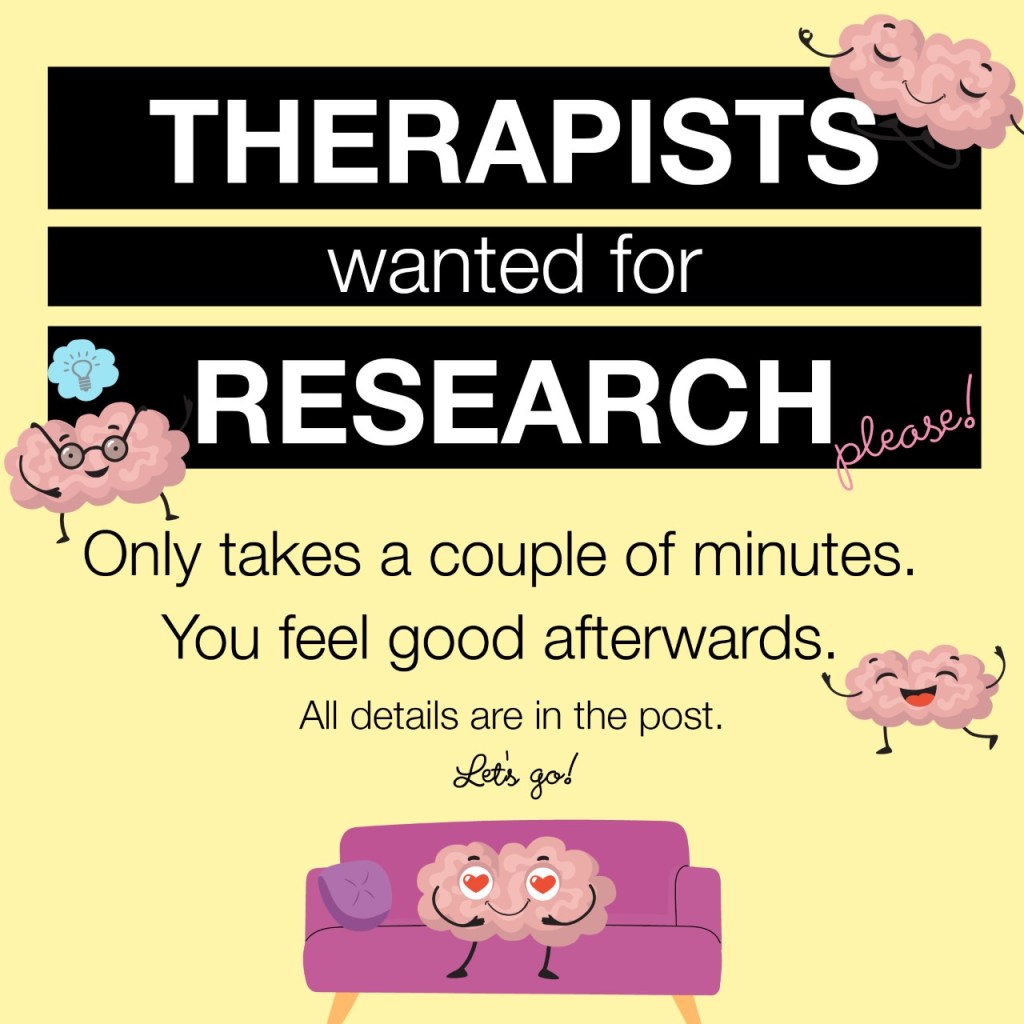
Calling Therapists to take part in a short research survey!

Dear colleague, are you a licensed therapist?

Would you be willing to take 8 minutes to fill out a questionnaire for a research study?

Your participation would be very much appreciated!

Please see details on the study below:

—————-

We cordially invite you to participate in a research study conducted by MSc students Martin, Paul, Katie, and Shabnam as part of Alef Trust’s graduate programme in Consciousness, Spirituality, and Transpersonal Psychology in collaboration with Liverpool John Moores University, UK,

The purpose of this study is to explore psychotherapists’ sense of connectedness with oneself, others, and the world.

If you meet the following participation criteria, we encourage you to complete an online questionnaire that will take approximately 8 minutes to finish:

– Licensed psychotherapist

– Minimum of 2 years of clinical practice

– Age between 30 to 60 years

– Proficient in the English language

If this is you, please follow the link below to access the questionnaire:

https://www.surveymonkey.co.uk/r/YFTTGL6

Your participation is voluntary, anonymous, and confidential, and you may withdraw at any time. Your responses will be used solely for research purposes.

If you have any queries or require additional information, please feel free to email any of us:

Martin Leitner: m.leitner@2021.ljmu.ac.uk

Paul Norris: P.S.Norris@2021.ljmu.ac.uk

Shabnam Faltenbach: s.v.faltenbacher@2021.ljmu.ac.uk

Katie Mottram: K.Mottram@2021.ljmu.ac.uk

Study Supervisor: Tadas Stumbrys, PhD. Email address: tadas.stumbrys@aleftrust.org

Thank you for considering contributing to this research project. Please feel free to share this with your networks.

With warm regards,

Martin, Paul, Katie and Shabnam

Posted in Uncategorized | 2 Comments