Shame and Self-trust

There must be something about transmuting shame rising in the collective right now. When I took part in a constellation for healing at the Integral Europe conference in 2015, guilt and shame came up as the central energetic blocks for humanity’s evolution. Now I’m writing up the results from my current research into the transformative meaning in ‘madness’, and shame has come up as a central catalyst for extreme states due to the ‘internal split’ it creates. So why is shame so common, and does it have a purpose to support our evolutionary shift?

When my dear friend Martha asked if I’d share her latest blog with the Emerging Proud community, it didn’t surprise me that shame was the central theme – we often find ourselves tapping into the same stream of consciousness. Here she discusses, as eloquently as always, the links between shame, Self-trust, belonging and spiritual crisis. Enjoy.

How do I move through this shame? This is a question that comes up repeatedly in my peer support work with people who have experienced spiritual crisis or psychosis. But shame is a universal human experience, not limited to integrating unusual or extreme states of consciousness. This piece explores the evolutionary purpose of shame and how to activate self-trust as an antidote.

Shame has evolved alongside humanity; cooperation and working together in groups set us apart from other primate species, granting us evolutionary longevity and dominance. Working cooperatively and being part of a group was so key to survival that breaking too many social rules would likely mean exile and early death.

 Therefore, when we feel shame, we experience an emotion that is deeply rooted in the human need for belonging, one which has evolved to deter (or protect us) from acting in ways that would socially devalue us and compromise our access to mutual aid through familial and tribal belonging.

Yet perhaps surprisingly, it is not the act of ‘doing wrong’ that is needed, or indeed enough to trigger shame. Research shows that being devalued, disliked, or oppressed by others can trigger shame even when individuals know they have done nothing wrong. 

The elicitor of shame therefore is not objective wrongdoing, but rather the threat or actuality of social devaluation.

In fact, shame-based living can involve doing all the right things- as mentioned above, we don’t need to have done anything inappropriate or wrong to experience shame.  But if we ask ourselves, ‘what is this do-good behaviour in service to?’  and the answer is- a fear of being bad (and the social consequences of that)- then we are still living through the binary lens of shame. A lens relies on external validation of our worth or lack thereof. Like many forms of binary thinking, shame-based thinking tends to see in black and white, good and bad, right and wrong. It lacks a tolerance for complexity, within oneself, and amongst others.

This is not to say that having a moral compass isn’t required. But the compass we need is within us, not in fear-based assumptions of what others will make of our decisions and choices. This is where I believe self trust comes in, as well as inner safety. When shame arises, there is a process of discernment needed, a sifting through of our own behaviour and that of others, to see with honest eyes and relative clarity, where action and change is required, and where that responsibility may lie with someone else.


Identifying where changes in behaviour need to be made is such circumstances is an example of adaptive guilt. A key difference between shame and guilt is that shame is hooked onto our identity, and says ‘I am bad’, whereas guilt focuses on behaviour and says ‘ I did something bad’. It becomes adaptive guilt when the inner compass of self-trust supports us in bearing the discomfort of seeing our behaviour and taking appropriate action, without becoming paralysed by shame.

Self-trust is directly linked to our instincts and the pool of deep intuitive knowing within each of us. When we are connected to it, we are motivated to behave in ways that are nourishing, meaningful and in integrity. And yet to make contact with this inner security and knowing, we need to feel safe enough to get quiet and still, to cease for a moment the relentless rush and listen to the quiet murmur of Soul.

This stillness can be a barrier to self trust in itself, especially for those dealing with unprocessed trauma. When there is a lack of internal safety, it may feel impossible to sit quietly with an experience as challenging as shame, in order to hear its message. Grounding and stabilisation work with a practitioner trained in embodied mindfulness or somatic practices can help to regulate the nervous system and build body awareness and somatic safety. In my experience this creates a solid foundation for further exploration of the inner world.

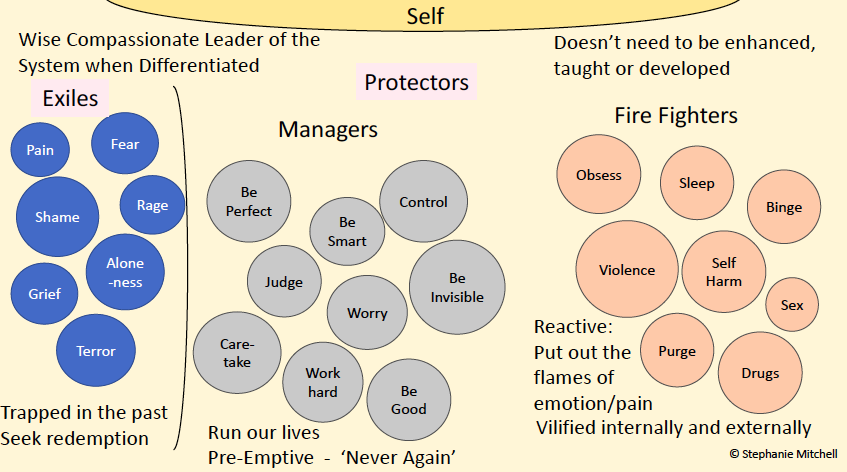
Once a secure base within the self has been established, one way to gain a greater sense of self-trust is to become really familiar with one’s own psyche. That might be through a framework like Internal Family Systems (IFS), where conflicting inner ‘parts’ are given space to be listened to, understood and unburdened. Alternatively a Jungian approach of understanding the prominent archetypal complexes within the psyche, through dreamwork or visualisations might appeal.

Walking the landscape of our inner world, feeling the ground of one’s own Being and perceiving our innate multiplicity, can build trust in our capacity to face ourselves.
Both Jungian and IFS approaches recognise that the inner world is not made up simply of the Self, but a multitude of different parts, complexes, energies- often with conflicting viewpoints, needs or agendas. Getting to know the many facets of our inner world can be very useful in navigating shame, because it creates a compassionate container for and clearer understanding of the parts of our selves that may be acting in ways that our against our best interests, without denying aspects of the psyche that are healthy, positive and nurturing. This form of self inquiry facilitates a precise and nuanced understanding of where we are distorted, without needing to identify with that distortion as all that we are, piling yet more shame upon ourselves.

There will always be shadows in the land of the psyche, especially when we are shining a light, inquiring into dusty, unfamiliar corners of the inner world. But by listening to the parts, contemplating the dream images, and following the threads that are shown to us, a steady confidence and trust emerges in the self to be able to confront darkness, threat, fear or shame with curiosity, courage and compassion.

We might notice that synchronicities increase when we are deep in the depths of such investigations. As Jungian analyst James Hollis notes, the psyche will always support that which is meaningful. And when the outer and inner worlds begin to weave inexplicably together, we know we are being supported to continue.

When we become wanderers of the psyche, we increase our tolerance for staying with the unruly, disturbing or uncomfortable- including the experience of shame.

With this growing capacity, we can start to perceive the innocence and humanity at the heart of shame. Let’s remember that shame is essentially driven by a need to belong, and the real or perceived threat to that belonging. What human doesn’t want to belong? Just like the newborn baby, who will perish if rejected or exiled, we have evolved to need each other. This reframing of shame can transmute it from a paralysing experience to one that reminds us of our common humanity.

For those of us who have experienced a spiritual crisis, non-ordinary states or a psychosis of some kind, the idea of belonging can feel distant, unreachable or like something from the past, that no longer applies. When no one around you understands your experience, this alone could be enough to trigger the threat of social devaluation and shame. How do we fit, now that our whole worldview has changed? Who do we speak to, and about what, now that what’s important to us has shifted entirely? The dismantling of identity that often accompanies a spiritual crisis (or any crisis in fact) can bring forth shame with ease. What is our value, socially, if we don’t even know who we are anymore?

This is where community and high quality peer support can provide a container- for navigating shame and re-building self-trust after a period of crisis. Having key aspects of our experience and insights understood and mirrored in the experience and wisdom of others can alleviate the sense of exile that is so common after internal journeys of depth.


As a spiritual emergency/psychosis peer, embodied mindfulness coach and astrologer, I offer a tailored approach to holding space for people looking for crisis integration support. The core of my work is based around my own experience of non-ordinary states: the recognition of my own distortion during that time, as well as the insights, compassion and transformation that were catalysed; and finally, my commitment to opposing iatrogenic harm from the psychiatric system and alleviating hermeneutical oppression through soulful, creative, empowered meaning making.

Access Martha’s original post and website here , or get in touch for a free consultation here.
Posted in Uncategorized | Tagged , , , , , , , , , | Leave a comment

Stephanie Mitchell talks about the non-pathologising approach of IFS, with a focus on experiences / processes that get called ‘psychosis’, and spiritual emergency…

I was inspired to start dipping a toe back into doing Emerging Proud interviews by my dear friend Stephanie, as I’ve learned so much from her through our conversations over the past couple of years.

So here we are, raw and unedited – Stephanie and I both felt a little ‘squirmy’ about putting this out, but nothing is ever perfect is it? Hopefully it’s helpful (Apologies for the internet blips too).

An interview with Stephanie Mitchell, 01/06/24

Stephanie Mitchell is an Australian based Internal Family Systems psychotherapist who specialises in working with clients who have experienced childhood trauma, and those who experience labels of BPD or psychosis. She also offers workshops for professionals on working with IFS and early developmental trauma. You can find out more about Stephanie’s work on her website: https://www.stephaniemitchell.com.au/

Links to work mentioned during the interview:

Stephanie’s video I mention: ‘Self has no power not granted by Parts’

Stephanie honours the teachings of the Founder of IFS, Richard (Dick) Schwartz and mentions this podcast

The Power Threat Meaning Framework (Dr Lucy Johnstone, Prof Mary Boyle, Eleanor Longden and team)

Matt Ball and The Humane Clinic – latest paper on ‘Dissociachotic’

Dr Chalie Heriot-Maitland and his latest paper on shame, and the influence of social norms on dissociation

 Oryx Cohen and PJ Moynihan’s Film Healing Voices

We talked about a collaboration which is in the pipeline for an IFS course for Peers with IMROC

Books:

Kalsched, D. Trauma and the Soul and The inner world of trauma: archetypal defenses

Moscowitz: Psychosis, Trauma and Dissociation: Evolving Perspectives on Severe Psychopathology

 Altogether Us: Integrating the IFS Model with Key Modalities, Communities, and Trends, by Jenna Riemersma

Robert Falconer: The others within us

Peter Levine: Waking the tiger

This image, created by Stephanie, depicts how IFS understands how trauma causes dissociation, the different roles Parts play, and resulting behaviours that can manifest. All Parts need the loving attention of the Self in order to feel safe enough to give up their role and bring in their natural qualities. 

Image Source: Stephanie Mitchell. (This image is solely Stephanies)

Posted in Uncategorized | Leave a comment

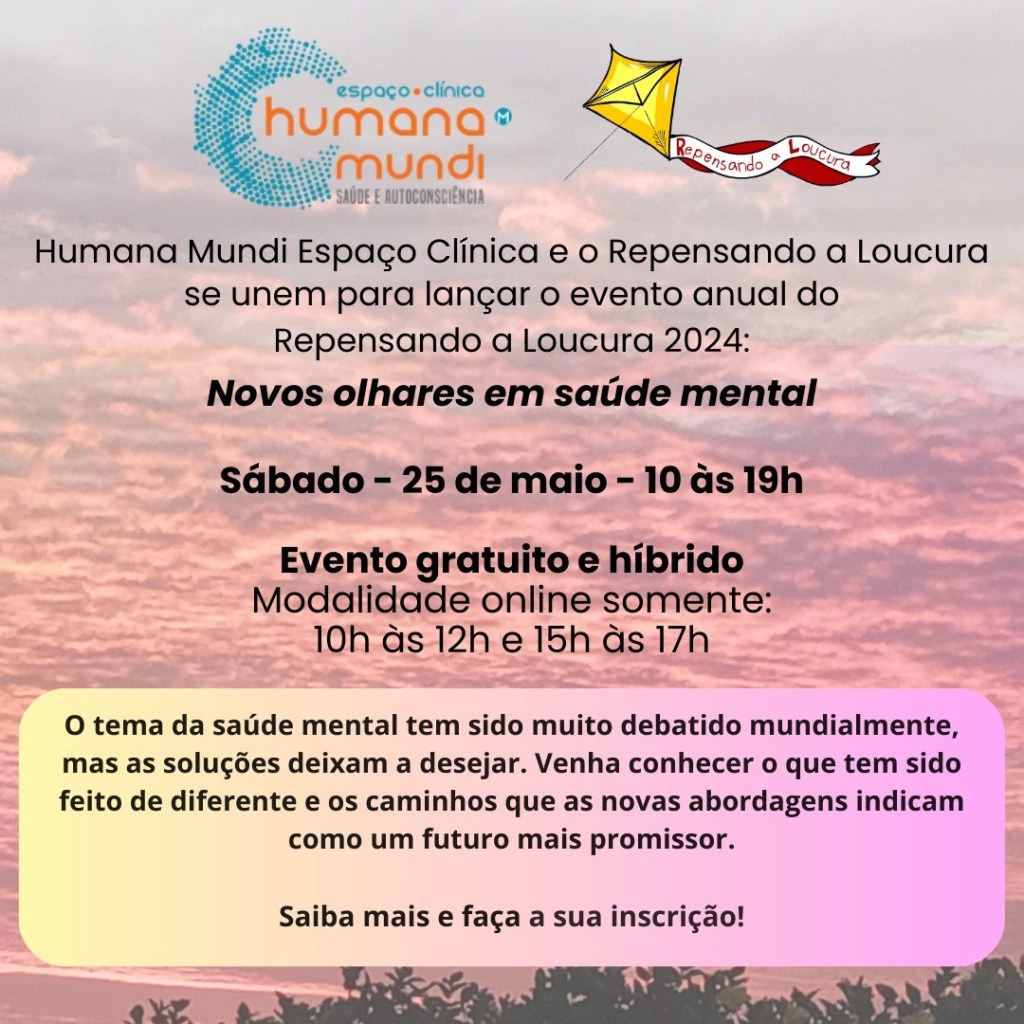
New views on mental health; join the 8th Brazilian event with team ‘Repensando a Madness’ (Rethinking Madness)

The Brazilian #EmergingProud chapter have done us proud again by keeping the annual celebrations and conversations going – this hybrid event will be in Portugese, but we have translated the information so that the non-Portugese speaking Emerging Proud community can see what is happening! Huge kudos to Ligia, Maria and team for your ongoing dedication ❤

With great joy, we invite you to participate in the event: New Views on Mental Health.

The eighth annual Repensando a Madness event will be online and in person thanks to the support of @humanamundi ♥️

Saturday – May 25th
In-person mode:
10am to 7pm (Reception from 9am. Rua Cordilleras, 163 – Vila Leopoldina – São Paulo.)

Online mode:
10am to 12pm
3pm to 5pm

We will continue to open space for dialogue between psychiatrists, psychologists and people who go through experiences of great psychological suffering and profound transformation, who have a lot to contribute by sharing their stories of overcoming.

To register and for more information click here

Click here to follow Repensando a Madura on Instagram

Translated from original content:

Com muita alegria, convidamos você a participar do evento: Novos Olhares em Saúde Mental.

O oitavo evento anual do Repensando a Loucura será online e presencial graças ao apoio da @humanamundi ♥️

Sábado – 25 de maio

Modalidade presencial:

10h às 19h (Recepção a partir das 9h. Rua Cordilheiras, 163 – Vila Leopoldina – São Paulo.) 

Modalidade online:

10h às 12h

15h às 17h

Vamos continuar abrindo espaço de diálogo entre psiquiatras, psicólogos e as pessoas que passam por experiências de grande sofrimento psíquico e profunda transformação, que têm muito a colaborar compartilhando suas histórias de superação. 

Inscrições e mais informações:

Quem quiser, pode seguir o Repensando a Loucura pelo Insta:

Posted in Uncategorized | Leave a comment

‘Doing It Deliciously’ join a free online embodiment retreat – Let’s Heal in Ways That Feel Like Love

Remember our Proud Emergee Ellie Paskell? She emerged through a challenging kundalini awakening journey and has flourished into an incredible embodiment coach, award winning creative and guide for those journeying with dis-ease… what a transformation!

Ellie is hosting an exciting five day online embodiment retreat which brings together 23 of the world’s most visionary somatic space holders to support attendees to align their lives with aliveness – and we’re all invited!

This is an utterly unique event and you can click here to take your place FREE ​!

Millions of us across the globe are ready for another way. 

A way that puts pleasure and aliveness at the centre of our world. 

A way which welcomes all of who we are and recognises that honouring the body isn’t the antithesis of capability and strength but the foundation of those things.

You’re here for rest, inspiration, self governance and flow! Enough of bowing to the insane idea that life’s about struggle; that in order to be sensible we must suppress our souls

It’s a crock.

Your  body is a finely tuned guidance system which, when honoured, leads you to align with love and rebirth our world. Rest leads to replenishment; inspiration leads to love…

The wisdom of the felt sense is unquestionable.

So whether it’s gotten your attention with anxiety, exhaustion, inspiration or pain – your passions are priority and this is your permission slip to honour yourself by following what feels good. If your cells are saying ‘yess’ to this and your spine’s relaxing with relief, I’m excited to invite you to join me at an event that will support you to do exactly that. This is the: 

Doing it Deliciously Embodiment Retreat from the 20th – 24th May 2024: click here to take your place FREE ​!

​20+ somatic sessions, creative invitations and delicious discussions supporting you to revolutionise your life for aliveness.

Every session in the retreat supports you to evolve your life easefully and  deliciously in alignment with what feels good.​ So what you’re doing and how you’re doing it become reflections of the true you, complete with needs, vulnerabilities, effervescence and strength. Join us and enjoy: 

Guided embodiment practices

Artistic journeys

Movement, song, spoken word

Delicious discussion 

Body based tools and techniques

Somatic Ceremony

A ‘behind the scenes’ Doing it Deliciously video diary!

Work, rest, healing and play – find out what happens when you truly do it your body’s way. 

click here to take your place FREE ​!

Ellie has gathered 23 of the world’s most visionary somatic space holders, therapists, pleasure coaches, womb shamans, healers, high priestesses, artists and embodiment guides to bring Doing it Deliciously to you.

This retreat is here for you if you’re:  

~ Fast, busy, tired – ready for another way

~ Slow, sleepy, ‘sick’ – here for healing that feels like love 

~ Longing for the joy you had as a kid

Join us at the retreat and:

~ Harness the energy of desire

~ Evolve your life for deliciousness

~ Show up resourced, inspired and strong

And – 

*** Magical Bonus ***

Along with the 20+ embodiment sessions, when you join the Doing it Deliciously retreat you’ll receive access to 50+ videos from Ellie Paskell’s The Making of Doing it Deliciously Video Diary.

These behind-the-scenes broadcasts bring another level of inspiration and support to your journey; Ellie recorded them during her eight months producing the retreat and they reveal how she runs a business in the midst of a kundalini awakening. 

These will be available to you in addition to the 20+ experiential sessions – And I’d love to gather with you there. Enjoy! ❤

click here to take your place FREE ​!

Posted in Uncategorized | Tagged , , , , , | Leave a comment

Do you feel like you ‘lost time’ during your ‘psychosis’ experience? Would you be willing to share your thoughts on this for research purposes to inform support?

Woman stand in the middle of a foggy forest. There are big clocks scattered all around. Concept of time and chosing your right path.


ISPS are carrying out a study into the recovery journeys of people with lived experience of psychosis, and their perceptions of lost time in relation to psychosis and associated experiences. The study has received ethical approval from the University of Liverpool Research Ethics Committee.

Would you be willing to share your psychosis recovery story?

We are looking for volunteers to take part in research exploring the process of recovery from psychosis. The aim of this study is to better understand recovery journeys in people who have previous experience of psychosis in relation to how they might perceive of ‘lost time’. We hope that this will allow us to gain important insight into what may help to promote recovery from psychosis, and how this might better inform trauma-informed recovery pathways.  If you choose to take part you will be asked to participate in a one-to-one (online or in person) interview of around 60 minutes in length.

You are eligible to take part if:

  • You have a past diagnosis of psychosis.
  • You have been recovered for at least 12 months. You MUST self-identify as currently being in a period of recovery, and have had no significant intervention or crisis intervention from mental health services for the 12-month period. This includes community treatment orders and any period of hospitalisation for mental health care. This does not include routine medical appointments, such as medication reviews, general health visitor appointments, psychotherapy sessions or clinics.
  • You are 18+ years of age
  • You speak fluent English

If you are interested in taking part in this research, we would love to hear from you! Please contact: r.r.m.ardani@liverpool.ac.uk or vvass@liverpool.ac.uk for more information.

All the best,
Victoria

Dr. Victoria Vass, CPsychol, FHEA, AFBPsS

Senior Lecturer in Psychology | Director of Online Studies in Psychology 

Department of Psychology | Institute of Population Health | University of Liverpool
Room 2.56, Eleanor Rathbone Building, Bedford Street South, Liverpool, L69 7ZA
Tel: 0151 794 1402 | E-mail: vvass@liv.ac.uk| Web: https://www.liverpool.ac.uk/population-health/staff/victoria-vass/

Posted in Uncategorized | Tagged , , , , , , , , , , , | Leave a comment

World-first study proves the transformative power of Peer story- sharing

The fact that sharing our stories of emerging through adversity transformed is a powerful aid in the integration process won’t come as a surprise to the Emerging Proud community. However, sometimes these embodied knowings need to be grounded in academic research in order to be acknowledged within our current scientific paradigm.

As you know, some of the Emerging Proud stories were part of the 5 year research conducted by the Research into Recovery Team at Nottingham University in partnership with the Institute of Mental Health.

The NEON study – Narrative Experiences Online Intervention – gathered more than 600 stories from all over the world, drawing on existing, published work and digital repositories. The team collected 50 more of their own along the way, including several from people who had heard about the study and wanted to lend their voices.

The dedication of the team to this longitudinal study has paid off – the results prove that:

“If people have hope, they can try new things to find better routes to a brighter future.” Dr Stefan Rennick-Egglestone, lead Researcher on the NEON study.

This study is promoting a broader shift towards harnessing the power of story, of shared experience, in health care. That means less invasive treatments and more human connection – Power to the Peer!

Read the whole POSITIVE NEWS article here

Click HERE to read more about the findings of the study, or SIGN UP to the mailing list.

Relationship inspirational quote – Communication is good, but understanding is everything. Message on white paper with two roses in purple and yellow colors on old rusty typewriter vintage background.
Posted in Uncategorized | Leave a comment

Opportunity to take part in research on the Transformative Elements of Psychedelic and Near-Death Experiences, and their impact on beliefs about mortality

Have you experienced an NDE or psychedelic journey that has significantly impacted your views on death and dying? Would you like to share your views for research?

My colleague Agnieszka is conducting a research study titled:

“Exploring the Transformative Elements of Psychedelic and Near-Death Experiences: Impacts on Beliefs About Death Across the Adult Population,” in collaboration with ALEF TRUST and LIVERPOOL JOHN MOORES UNIVERSITY.

Her goal is to understand how NDEs and psychedelic experiences influence views on mortality, aiming to improve end-of-life care.

Participants are being sought who are:

  • over 18 year of age
  • have had significant experiences with NDEs or psychedelics that impacted their beliefs about death.

This study has received ethical approval from the Alef Trust Research Ethics Panel.

Do you fit the criteria? Your insights could greatly contribute to this interesting study.

If you’re interested or have any questions, please feel free to reach out to Agnieszka at  A.E.Marek@2021.ljmu.ac.uk.

Posted in Uncategorized | Tagged , , , , | Leave a comment

Emerging Proud reaches Korea – people are ready to emerge from the spiritual closet all over the world

When we gathered as a community in 2017 to pool all of our resources to make (a very amateur!) film, none of us envisaged just how far and wide Emerging Proud would spread and how many people it would support.

We’re all aware of the shame, stigma, and sometimes debilitatingly disempowering treatment people who try to talk openly about extreme altered states can experience – at the hands of disbelieving friends, colleagues, family and the current westernised mental health system.

But these experiences are not culture-bound, they connect us beyond any categories of difference.

Thanks to support by the ISEN team, Jeong Lee and his team in South Korea are setting up a new Spiritual Emergence Network to support people going through a difficult awakening process. It’s only people who have experienced this challenge who are equipped to support others – this is why it’s a grassroots movement.

Jeong Lee extends his gratitude to all involved in the Emerging Proud film, which has been translated into Korean for their website:

From the Korean Spiritual Emergence Network: https://spiritualawakening.social/

One of the major challenges of anyone who is / has gone through a challenging awakening process is explaining it, because the experiences themselves are beyond words.

The ‘3 minds model’ of Dr Anoop Kumar explains everything in such a tangible way. Dr Kumar experienced his awakening to universal consciousness as primary due to a near death experience, and he’s bringing back the information he received to his mission to create a de-colonised model for healthcare.

It’s time for a new paradigm, and you, proud emergees, are part of the sea change…. My eternal gratitude for everyone who has so bravely spoken out in order to create a safety for others to do the same. This is just the beginning…

With love, Katie ❤

Posted in Uncategorized | Tagged , , , , , , , , , , , , , , , , | Leave a comment

Emerging Proud: A campaign of hermeneutical dissent – thank you fellow Dissenters

Did you realise that, as Proud Emergees, we’re a group of hermeneutical Dissenters? Neither did I until I came across the incredible resource, Warp &Weft. Thank you to Lisa’s book, we as a community are now more deeply rooted in a theoretical framework.

As a group of non-conformists who suffered hermeneutical injustice (not having our interpretation of our experiences acknowledged) through epistemic injustice (having our ‘gnosis’ – embodied ‘knowing’ of our experiences, disregarded by those in power), we decided to step out of our spiritual closets, join forces, and proudly share our stories as part of creating a new hermeneutic (meaning /interpretation) for our ‘altered state’ experiences.

I (Katie) have been a little absent as I’ve immersed myself in research as a means to give credibility to our plight… I apologise for not ‘being so availably here’ (I am still here – 3 years in, another 4 to go!), please know this is for us all (and the many more to follow). We are the bridges between worlds and paradigms. Anyway, in case you haven’t come across it already….

Warp & Weft is an incredibly well-researched, comprehensive, astoundingly wise and compassionate resource on reframing human experiences that our culture has come to call ‘mental health’.

I’m going to quote the author, Lisa Fannen in describing Warp & Weft, as she does a much better job of it than I ever could:

Warp & Weft gathers together ideas, radical frameworks and reference points to explore consciousness, and ways of understanding experiences of distress as they occur within our social and systemic contexts.

It looks at what gets called ‘mental health’ and challenges the idea that our experiences of distress, struggle or variable consciousness are only ‘mental’. It challenges the way biomedicine splits mind from body and soul, and names that we are embodied beings, who are shaped by and unfold within the contexts we have inherited and live in.

It looks at some of the history of psychiatry and examines the ways it has been, and continues to be used as a colonial force. It reframes trauma; it looks at the effects of trauma in the bodymindsoul, acknowledges the intersection of personal and collective trauma, and explores ways we might move towards healing.

Warp & Weft considers how we are given cultural ‘scripts’ for experience, and how we might relanguage experience on our own, and non-medical terms. Terms which address root causes of distress and point towards holistic approaches, in order to foster liberatory personal and collective transformation.

Lisa Fannen

You can access the audio version of the book here for free:

https://lisafannen.bandcamp.com/album/warp-weft

However, if finances allow, please donate as Lisa’s dedication and woven genius needs to be rewarded. I personally think that she deserves an honorary doctorate for this work of art.

Offered with so much love, and solidarity as always, Katie ❤

Posted in Uncategorized | Tagged , , , , , , , , , , , , , , , , , , , , , , , , , | 1 Comment