Her quest for deeper meaning sadly gained Rachel a diagnosis of schizophrenia

Disempowered by the imposition of ‘care’ from services, Rachel has continued her quest for deeper meaning, and has found her spiritual practices have helped her to more deeply listen to her own suffering and that of others with more patience and compassion.

Rachel’s story is unfortunately not uncommon; services operating from fear and not stopping to give space to the individual’s perspective about their situation before enforcing an intervention. It’s understandable that Rachel’s dietary situation was a cause for concern, but if action could have been taken in a way that Rachel describes below; through a meeting of souls, infused by love and acceptance on both sides, then perhaps medication and diagnosis could have been avoided… 

Rachel S-P-2

In 2014 I found myself feeling lost and desperate for a way out. I discovered that it wasn’t that I didn’t want to live, but I didn’t want to live in the way I was living, thinking, and perceiving.

Then, one day, in order to facilitate my focus on meditation and spiritual study, and also partly to heal my digestive problems, the idea came to me to embark on an extended fast. This idea was validated by accounts I read online of how people had become physically and spiritually stronger and brighter through fasting. And so, for between 30 and 40 days, my diet subsisted of just water and the occasional glass of beetroot juice. I meditated extensively, read spiritual texts, particularly the Vedas and the Dhammapada, and while I began to realise just how much of a challenge it is to tame and train the mind, I also felt as if I had gained a spiritual purpose. Reading the scriptures, I felt a resounding affinity with those from throughout history to today who had embarked on this journey to realise the Self.

Meanwhile, after having had the results back from some blood tests, I agreed to eat again. For the doctor, this wasn’t soon enough, and my family, being concerned about my wellbeing, drove me to hospital. Upon declining medical intervention and then, after feeling I didn’t want to engage with the questions being asked, and consequently failing a capacity assessment, I was then sectioned under the Mental Health Act and detained in a psychiatric unit. From here, I was moved to an eating disorder unit and a feeding tube was inserted into my body. For the first night, I sat upright in meditation as two nurses held down my hands on either side, in case I tried to pull out the tube. This was something I never tried to do. The second day, the psychiatrist approached me about putting me on some anti-psychotic medication. I was shocked. Nonetheless, I explained to him in what I felt was a calm and rational manner why it was neither a helpful nor an appropriate idea. He said nothing and so begun a course of medication which I have been forced to take, on and off, from then and continuing into today. The medication had no discernible impact upon my state of mind, however, particularly in the early days, it did make me incredibly tired. This need to sleep most of the day was, I think, enhanced by what I felt was an excessive eating regime at the eating disorder unit – 6 meals (3 main meals and 3 sugary snacks a day) and if you weren’t completing your meals, then back on the feeding tube it was. The suspicion from the doctors that I had Anorexia was eventually replaced by a diagnosis of Dissociative Disorder. 

Since this first admission to the eating disorder unit, I have been in and out of hospital, both the eating disorder unit, and then, after my husband and I moved somewhere else, to a medium-secure psychiatric unit. The explanation from the doctors is that when I am on the medication I am well and when I come off the medication I fall ill again. For me, this explanation relies on a very narrow and prescriptive definition of what it means to be ‘well’ and does not take account of the validity of experiencing reality in a deeper, albeit sometimes more overwhelming, richer way. One example that I feel is symptomatic of this attitude which confines normality to a particular set of social and cultural standards, is that in the psychiatric unit where I have been a patient a number of times over the last few years, one marker of whether I was ‘getting better’ was whether I wanted or had chosen to (when I was given more freedom of movement) go to the nearby Tesco supermarket. 

In contrast to the strict routine at the eating disorder unit, the psychiatric unit lacked any structure. Nonetheless, by this time, I had developed my own routine of meditation, yoga, mindful slow walking and reading, particularly in the mornings and evenings, which I found helpful. According to the consultant, however, the fact that I was more unresponsive at these times (when I was meditating) was a sign that I was particularly afflicted by my ‘illness’ (which had by this point been re-diagnosed as Schizophrenia). 

Despite the oppressiveness of the situations I have found myself in within the mental health system, light and grace have managed to find ways into my life. In the eating disorder unit, for example, there were a handful of nurses and health care assistants with whom I had some wonderful interactions. They too were embarking on a journey of their own spiritual discovery and so we would share insights together, swap books and interact as equals, as spiritual comrades, in spite of the risk (and one occasion actuality) of them being reprimanded by the consultant for ‘encouraging’ me. Another gift at this time came in the form of being asked by staff at the unit if I would, on occasions, lead a weekly, hour long relaxation group. Leading patients and some staff through improvised guided mediations/relaxation exercises provided an opening for me to channel my wish to be of some support to others. This experience was a real privilege and something that I was able to continue at the psychiatric unit on an individual basis when asked by patients if I would teach them meditation. Perhaps partly because I didn’t want to perpetuate the judgmental tendencies that had been inflicted upon me by certain people, and perhaps also because of meditation having helped me to see my own suffering with more clarity and compassion, I found that more than at other times in my life I had a greater capacity to listen to the experiences of others. This led to several encounters with patients, some of whom had spent decades in psychiatric units, that really felt like a meeting of souls, infused by love and acceptance on both sides.

Although not always so easy, I have found it essential not to become angry or blame those who have led to my repeated detentions. The chances are that those involved are also suffering, and that is something I remind myself I would not want to add to by any ill-will on my part. Of course, I too make mistakes but the more I am able to practice kindness, tolerance, acceptance etc., virtues which arise from daring to look at and experience life deeply, the more I am able to find peace in difficult situations. In this way, I wish to offer encouragement to those who have or are facing similarly challenging situations not to give up on what they know in their heart to be good and true.

In the beautiful words of Zen master Thich Nhat Hanh: “Regardless of where you are, let us breathe in and out together, and let the Sun of Awareness enter.”

Have you #Emerged Proud through a diagnosis of ‘psychosis’ or ‘schizophrenia’ and want to join Rachel in having your voice heard about your own perspective of your experience?

To find out how to share your story for our amazing 5th Pocket Book of Hope; 

#Emerging Proud through Psychosis and Schizophrenia 

CONTACT US HERE 

 

Posted in Uncategorized | 1 Comment

Once a walking contradiction, now Suhur lives with a passion and purpose to help others

It took a brush with the possibility of losing her life for Suhur to realise that she needed to stop hiding her truth behind a facade of perfection and become the mother to her own hurting inner child. Now Suhur reflects back on this painful time in her life as a blessing, as it was the push she needed to change the way she was seeing herself. Whether you choose to share Suhur’s belief that this was God’s work or not doesn’t really matter, what matters is that when we dare to let down our guard and face our deepest, darkest parts of ourselves, as Suhur was brave enough to do, that is where the magic happens…

Suhurwithlogo

It took me a long time to come to a conclusion that Islam as a religion is pure but us as Muslims have faults and are imperfect, especially when we mix religion with culture.

As a 23-year-old Somali Muslim woman I have always known there is a lot of stigma and discrimination towards people with mental and emotional distress.

I think that we live in a culture that values strength and perseverance and has this very naive belief that everyone is born in the same circumstances with the same bodies and the same brains that work the way they’re supposed to work.

The challenges British Muslims with mental distress face within the community is stigma and labelling, disrespect and being ignored and the accusations of not being a good practising Muslim. Also the barriers people from Muslim and Somali – African backgrounds face is the lack of mental health literacy, culture of silence particularly amongst men, and also fear and negative speculation about mental health services and systems

The stigma is the biggest challenge.

Though labelling and stigma attached to people with emotional distress is rather common among other societies also, it is more intense and more evident in communities that hold the kinship network in high regard. In a nutshell, people with mental distress are stigmatised and accused of being incurable. Distress is seen as being precipitated by individuals not being good practising Muslims. Their families are also stigmatised and accused of not raising their children properly and in Islamic ways. People with emotional issues are ignored by the mainstream community members and they are not talked to, assuming that they are worthless, and their talk is nonsense and a waste of time.

I myself suffered from depression, suicidal thoughts and anxiety. I constantly felt like a walking contradiction. I had dreams and goals that I wanted to achieve and lots of amazing ideas and plans bursting to come out of me, but I felt stuck and blocked. I couldn’t consistently act on the things I knew would benefit me and the pressure around it all gave me crippling anxiety which slowed me down further. These patterns developed into a guilt so heavy, it made me dislike myself. Disliking yourself is like hell on earth and the worst way to go through life.

There would be days I would close the blinds get a duvet, snuggle up on the sofa or my bed and just look up at the ceiling and wouldn’t move for days. Other days I would be super productive, and nothing could hold me down.

Nobody knew and still till this day some people don’t know that that girl who had a full face of make-up on and with a smile on her face the size of a watermelon was broken deep down inside.

I found myself constantly questioning my purpose and what it was that I was brought into this world to do because I’ve always known it was nothing average.

I attempted to take my own life in 2017; I remember being in the ambulance with the sirens on, racing to the hospital and it raining so heavily. Through the raindrops on the roof of the ambulance I could hear the paramedic saying to my friend as I came in and out of consciousness “Her heart rate is very high” and “she could die” but I didn’t. I am alive for a reason. A purpose. I arrived at the hospital and had my stomach flushed of all the pills I had tried overdosing on. I remember the nurses coming in and saying, “you beautiful girl, why on earth would you do this” and “It will all be okay” all whilst stroking my hair as I looked blankly up at the ceiling avoiding eye contact at all costs.

In the Quran rain is one of the most important factors for life on the earth. Rain carries great importance for all living things including human beings and is a Barakah (a Blessing).

This was my sign. This experience was a blessing. Only lessons and a stronger version of myself was to come from this.

I find such beauty now in being completely broken and rebuilding yourself and that is what kept me going. It was so hard, but I’ve learned it’s all about mastering the balance, you are bound to wobble but it’s how you regain that position that matters.

I truly believe Allah (God) has a plan, is the best of planners and only tests the ones he loves the most.

I’ve never wanted to boast about my suffering of life because there is always somebody who has it worse, I’ve never wanted sympathy. Just for people to try to understand what I am signifying and learn from it. Mental pain can appear less dramatic than physical pain, but it is more common and can also be harder to bear. The frequent attempt to conceal mental pain increases the burden.

It is time we change the mindset around mental health.

I hope to continue pushing for mental health to be a part of schools’ curriculums and educate young people.

I hope to bring together communities for discussions on this topic and organise events around mental health.

I always knew I would be great from a young age, but I just didn’t know how, now I know it is through helping others by sharing my own experience and breaking this stigma.

Here is a little message to you…

The same month of my suicide attempt, exactly a year later, I had a beautiful daughter and life has been just phenomenal.

Being willing to meet the darkest and deepest part of yourself without any judgement or harshness but being the maternal mother for your inner broken child that the world stepped on is the only way to heal. Giving yourself all the love and light you are desperately seeking outwardly is the only way to heal. The willingness to change the way you see yourself, self-love and putting yourself first is the only way to heal, crying over the old you and welcoming the new you is the only way to heal.

Never give power to the things that broke you or WHO broke you.

Don’t be afraid to step forward and be a better you.

Are you a Muslim who has #Emerged Proud through your own personal struggles and want to join Suhur in speaking out to end stigma and start new conversations within your kinship and beyond?

To find out how to share your story for this amazing Pocket Book of Hope,

CONTACT US HERE 

Posted in Uncategorized | Leave a comment

Global collaborative opportunity for #Emerging Proud

Dear #Emerging Proud Supporters,
An exciting opportunity has presented itself to us as a collective for this years #EP day celebrations and, more importantly, beyond…

As we are all aware, the world is in crisis… we’re in a process of transformation and it’s up to us to come together to ensure that transformation is a positive one.

We appear to be amidst a shift in human evolution, a shift to a different state of consciousness; from fragmentation to integration where we’ll see society developing into a more collaborative / co- creative organism … It’s time to integrate the #Emerging Proud movement with the wider movement for social change. 

Together

CLICK HERE to read a short document which outlines this opportunity to take #Emerging Proud forwards together into a more collaborative space – we need as many of you in as many geographical locations as possible to help to realise this vision.  Join us! 

Thank you again, so very much for all of your incredible efforts to make #Emerging Proud such a success – I can’t express in words my gratitude.

In solidarity for the shift,

Katie ❤️

Posted in Uncategorized | 5 Comments

Global Spiritual Emergency Research – Invitation to Participate

*Please note that #EmergingProud does not support differential diagnosis; (ie we do not believe that there is a definitive line between spiritual emergence and ‘illness’, but see spiritual experiences and mental distress more as a complex continuum in relation to trauma), however, we do support research in this field. Please take part in this study if you feel drawn / share with your networks;

*Global Spiritual Emergency Research – Invitation to Participate

Outlook-ai3ywg32

A new research project at The University of Adelaide, Australia, is seeking people who have experienced extreme psychological states/spiritual emergency/transformational experiences for an investigation into extra sensory phenomena.

In our current paradigm we have no road map for extreme psychological states and many struggling to understand their experience may be misdiagnosed as having some form of mental illness. Research into spiritual emergency aims to clarify the differences between spiritual emergency and mental illness.

To participate in this current project you will need a computer or laptop with internet connection and a quiet space where you can work uninterrupted for approximately 35 minutes. Participation will include responding to a few questionnaires about spirituality, unusual experiences and paranormal beliefs. This will be followed by a 10 minute creative visualisation audio track (you will need to wear headphones for this), a simple number generator task and a picture recognition task.

If you are interested in participating, please contact Monika Goretzki PhD at the University of Adelaide for an access code. Monika.goretzki@adelaide.edu.au

Kind Regards
Monika Goretzki PhD
Visiting Research Fellow
The University of Adelaide
monika.goretzki@adelaide.edu.au

Posted in Uncategorized | 1 Comment

Sophia had to learn to love the person in the mirror in order to heal

Experiencing what we perceive to be a ‘miracle’ can happen to any of us, irrelevant of our religious, spiritual or cultural beliefs. But what it leads us to ultimately is the same thing; self- discovery and self- acceptance; that can be our saving grace as Sophia describes through her own story below. Silently screaming for help through self- starvation at a young age, Sophia discovered that the person she most needed to seek support from was the person in the mirror…

Sophia -2

I have always believed that I was meant for something more, something deeper, something purer, than what I was subjected to.

Although I never quite figured out what that something was.

I have now, and I’m living it every day.

I do not know when it actually all began. What I do know, for as long as I can remember, is that I felt as though there was no place for me in this world. I now no longer feel that way.

I was unhappy for a long time; I remember thinking and feeling one day at only the tender age of 12 years old that I could not carry on any longer.

I started to starve myself, only living on water and crackers. I used to use a newspaper underneath my plate to hide and tuck away my food, whilst I would watch my family eating, talking and laughing. I only started with dinner, eating only breakfast, then one day I just stopped eating. I did not keep count of how many days or months this went on. I remember occasionally looking in the mirror and not recognising myself and feeling incredibly faint all the time. Then one day I caught a reflection of myself as I lifted my top up, I remember all I could see was bones and then I realised my clothes no longer could fit me.

In my world it was the only thing I could control in the midst of all the changes, the loss I suffered and the pain I felt, no one was asking questions. Then one day at the dinner table an aunt of mine demanded that I showed her what was underneath my newspaper and finally my time was up. It was a series of many things that followed, a way that I could only express that I was hurting, and I needed someone to listen to my pain, my trauma, the trauma that I had suffered at such a young age.

The first time that I thought about suicide was at the age of 16. I had a discussion with myself and I convinced myself that this was the only way forward and nothing else was going to get better. I looked at all the pills that I was beginning to take then suddenly I started crying, I started to think about my dad and how he was cruelly taken away from me out of this world, forever gone and never coming back. How much I missed him, how much I wanted him to be part of my life.

Then I started to call on Allah (God) to give me strength for I felt so weak and at only 16 so much had happened to me and looking at another 16 years of my life felt impossible to endure. I cannot explain in words the events that followed next. I was not really spiritual, but I believed in Allah and I certainly believed in miracles. I felt a wave of comfort envelope me and I sat up, for I do not know how many hours. I just sat, and cried until I slept. I believe that Allah saved me that night and I know that He wanted me for better things.

After a few years in therapy, working thorough my trauma from my childhood, more than sixteen years later, I now feel a lot happier. I have two beautiful children whom I absolutely adore and love myself for allowing them to have me as their mum.

Mental distress is not like someone will come with a magic wand and wipe away all the past and the pain it leaves behind with unbearable memories. My mental distress was something that I needed to accept and work through with a professional and recognise that despite the desperation of a quick fix, I needed to value me and be patient with the healing process because I promise you, just like a broken bone heals, your heart will heal to. I needed to love myself. I needed to understand that I was broken, I was hurt at a young age and it was not my fault. Allah had given me a chance to tell others that there is nothing to be ashamed of, your brokenness is what makes you who you are. It was and it is a part of me and although at times things will be difficult as life has its ups and downs, its highs and lows, it does and will get better and the only way when you are down is up.

There were times when I felt ashamed of carrying these wounds as a Muslim, as a practicing Muslim. Praying all my prayers attending sermons but still feeling hurt, angry and wounded. But I learnt after some time, that Allah loves everyone broken, wounded, hurt, abused. He (Al Wudud) which is one of Allah’s 99 names which means (the most loving) loves us all in whatever size, form or emotionally distressed we are. It was the person in the mirror that struggled to love me and accept what we had been through but without those experiences, the pain, I would not be who I am today. 

I was quickly reminded of how fast you can fall back down and not want to get up again, if you do not keep up with the healing process. But I did get up and I did it in style by choosing myself and loving me again, and taking better care of me, and Islam is all about self-care and loving yourself!

Do you identify as a Muslim having been through emotional distress which has made you stronger? Would you like to join Sophia and the other brave voices aiming to end this silent stigma and #Emerge Proud for your own community and humanity united?

CONTACT US HERE to find out how to share your story for our 6th Pocket Book of Hope;

Muslims #Emerging Proud through Mental Distress 

Posted in Uncategorized | 1 Comment

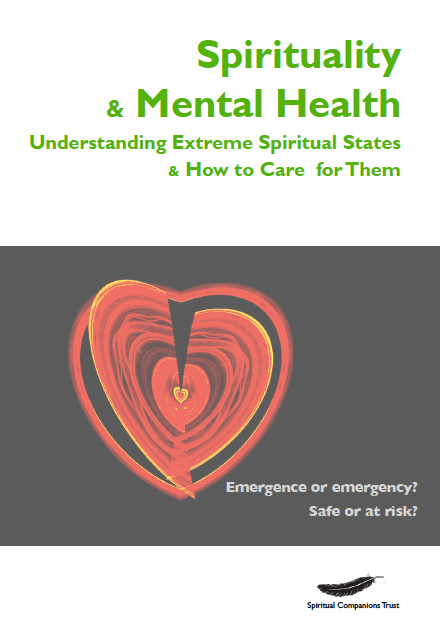
Extreme spiritual states and how to care for them; new Spiritual Companions Trust Brochure

A FREE ‘How to care for extreme spiritual states’ brochure has been made available by our friends the Spiritual Companions Trust, UK. Please help to raise awareness about this valuable document…

\Screenshot 2020-02-09 at 10.53.16

CONTENTS

Overview
Six Dynamics
— Presence & Energy
— Spirits
— The Path
— Meaning
— Belonging
— Identity
The Unconscious
Extreme Spiritual Behaviours
Emergence or Emergency?
Care & Intervention
Resources


Download the PDF Spirituality & Mental Health

To order printed copies please contact the SCT administrator by clicking here

Overview

Reassurance and Safety

The purpose of this booklet is to help the reader better understand extreme spiritual states.  It is written for people experiencing those states and also for their companions and carers.  Our goal is to reassure, create safety and enable positive outcomes.

This booklet is published by the Spiritual Companions Trust. We are very familiar with extreme spiritual states and spiritual crises. This comes from supporting others and from navigating our own challenges. In the context of spiritual development we accept these extreme states as normal.

Although these states are normal, we know that they can also be distressing. They can be distressing for the individual experiencing them and for those around them. Our hope is that everyone will benefit from a better understanding.

Inclusivity

This can also be a very sensitive topic. There is a history of spiritual states being misdiagnosed as mental illness. There are also cultural challenges. What is normal behaviour in one culture can be abnormal in another. Bliss, ecstasy, despair, shaking, quaking, visions, retreat, asceticism, talking with spirits, gift of tongues, hearing voices.  All these may be acceptable in someone’s home cultures, but frightening or risky in another.

This booklet asserts that to understand and interpret extreme or unusual spiritual states, it is necessary to be culturally inclusive. It is also necessary to appreciate both the psychological and the spiritual dynamics. If we look up a definition of  the word ‘psyche’ we will find: soul, mind, spirit. Both spirituality and psychology explore who we are.

This is a complex and tender subject. To be helpful and accessible we know that we have risked over-simplification. We apologise for that and hope that our approach is supportive and useful.

William Bloom
Director, Spiritual Companions Trust
Glastonbury 2020


Posted in Uncategorized | Leave a comment

Ayan #Emerges Proud as our 6th KindaProud Pocket Book of Hope Rep

We are delighted to announce the next Rep for our KindaProud Pocket Book series; Ayan Hussein, who is spearheading our 6th book;

Muslims #Emerging Proud through Mental Distress 

Like anyone who has been through a challenging journey and found their more authentic Self as a result, Ayan learned that speaking openly about her distress in a safe space, where she could feel heard and validated enough to make sense of her emotions, was the key to her transformation. Ayan has found her purpose through her pain to support others to speak out and have their distress normalised. Here Ayan describes her journey…

Ayan Rep

I suffered…

During the first few months of being a mother, I remember feeling different within myself. I was often feeling sad for long periods of time.

I looked in the mirror and realised that I didn’t know who I was anymore. 

I let myself go physically, emotionally and mentally.

I was on autopilot, going through the motions and doing what I had to do as a mother.

Despite this, I would always force a smile in front of others. After all I didn’t want anyone to judge me on my parenting and see me as a ‘weak’ person. I would constantly feel tearful and hopeless despite having this “happy mask” on display for others. I was often feeling suicidal, not really to end my life but rather to end my pain.

I recall a day when a family member was talking about mothers that experience symptoms of postnatal depression and the baby blues. I remember thinking that’s exactly how I was feeling. No sooner had I convinced myself I was depressed, than another family member declared; “We are Muslims and we shouldn’t feel depressed, it is not in our culture or religion”.

The day after my eldest was born, a lump appeared in my throat. After a year of many medical tests, the doctors confirmed the lump was a benign tumor, but shortly after I began to experience breathing difficulties. After several hospital visits and further tests it was becoming increasingly clear that the doctors were no further forward in understanding my symptoms. 

At that moment my family decided that Ruqya treatment, a form of exorcism in Islam practiced by a Raqi (spiritual healer), might be the answer. Ruqya in Islam is the recitation of the Quran, remembrance and supplications, all used as a means of treating sickness. 

My first experience of Ruqya was not a true representation of Islam. Unfortunately, the Raqi abused his power. Spiritual leaders/healers are in a position of trust. It was during this time I was feeling extremely vulnerable and my family turned to this person for support. It was clear he was exerting control over my family, for personal aims and financial gains. This raqi willfully electrocuted my hands while he recited the Quranic verses, under the false pretense of destroying the bad entity that was inside me.

Things took a turn for the worse; I was not able to eat or sleep for two weeks and I began to feel extremely tormented inside. During this period, I experienced several moments involving the apparent perception of something not present to others, which included seeing visions of strange looking people and hearing voices. These moments became worse at night, which made it almost impossible for me to sleep. I also became extremely paranoid of everyone around me, including my own family. I was taken to the nearest Accident & Emergency Centre and my symptoms intensified. During this period, I was in a complete state of shock to the point where I was muted for a few days.

It didn’t end there, I suffered from a major breakdown in my mental wellbeing again after the birth of my second daughter, two years after my first experience of severe mental distress. Yet again my family got worried when I started to get the same symptoms and decided to call a raqi.

Once again I became extremely ill straight after the session with the raqi and my family again took me straight to A&E. My symptoms were so intense to the degree that I believed the hospital staff were sent to capture me. Therefore I became suspicious of their actions. 

This led me to become both physically and verbally violent and I was sectioned under the Mental Health Act.

I was taken to the Goodmayes psychiatric hospital. I can recall at one-point staff members were trying to restrain me down. An extreme feeling of fear took over me and I was desperate to get away. There are no words to describe what this experience was like. For some, this matter may seem unimaginable, however only someone who has had this experience might relate. I was eventually given an injection and it knocked me out.

Approximately 2 days later, I had a better awareness of my surroundings and I couldn’t comprehend why I was in hospital amongst people that seemed very unwell.

Eventually, I was moved to a mother and baby unit and this admission marked the beginning of my recovery journey.

Little did I know, when I began this journey, how difficult it was going to be.

Throughout the years, I faced struggles and inner feelings of anger, bitterness, confusion, rejection, and denial. I guess this was due to stigma, which includes self-stigma, lack of acceptance, and lack of knowledge and understanding of mental and emotional distress. I found myself constantly dwelling on the past and projecting it into the future. I frequently experienced flashbacks of the spiritual abuse I suffered.

The turning point was when the urge I had to take responsibility for my life was becoming increasingly irresistible.

I learned….

I have been on a journey of discovery searching and exploring for different approaches that could aid me in becoming a more emotionally healthy individual. As part of this journey, I have completed a Diploma in counselling skills, emotional health mentoring course and volunteered for various mental health organisations that focus on improving people’s lives. This marked the beginning of my journey of self-research and personal development.

I was part of a research project called ENRICH as a peer worker, which was conducted within the East London Foundation Trust. The 3 years working as a Peer worker for ENRICH, where everyone from the project manager, peer coordinators, researchers and the peer workers all had lived experience. This was the most incredible life changing experience. During this time, I was fortunate to be able to articulate my lived experience and make sense of it.

The most rewarding lesson I learned from ENRICH was the concept of boundaries, both professionally and personally. Setting boundaries based on values that are important to me helps me live a truer life to my authentic self.

For the first time I felt validated, I felt heard, I found clarification to my distress. Healing happens in restoring our lives, sharing our stories in a safe space, without feeling judged or being labeled as our symptoms.

I’ve managed to work through some of my painful traumatic events and incidents from childhood that I had suppressed for many years. I learned not to ignore these feelings and emotions, which makes me feel empowered and strong. I also learned how to help someone else go through it.

I have turned my pain into purpose.

The biggest thing that I’ve realised is that my childhood, my life journey so far and my diverse good and bad experiences, all of these things that I used to think defined me actually don’t define me. Living in the here-and-now defines me. I can only thank Allah (God) for this journey of inner peace and contentment. 

“Allah is the best of planners.” (Quran 3:54)

However that does not mean I do not sometimes struggle with my emotions or get overwhelmed. I have now gained the tools and techniques that help me bounce back to reality and support me in being emotionally healthier. 

Other methods that have assisted me include CBT therapy, Ruqya from a qualified raqi, and a variety of workshops that cover personal and spiritual development. I undertook counselling with a Muslim counsellor who enabled me to understand what I was going through. I feel that understanding is the key to recovery, the more I learned about my situation the less I feared it.  

Taking a holistic approach rather than focusing on one type of method, for example, religious practices have supported me hugely.

Having a great support network also aids one’s recovery journey.

When emotional distress enters a family, the emotional cost can be high and family members can be deeply affected. My family are incredibly supportive, I wouldn’t be writing my story if it weren’t for their continuous support. I believe they have embarked on this journey with me and therefore individually changed for the better. 

I changed…

The recovery journey is unique and a continuous one of learning and growing and I’m still on that journey. My lived experience of emotional distress has been extremely hard and bitter, but I am the closest to being my authentic self than I ever have been, which is rewarding!

I love the woman I’m becoming, full of empathy, compassion, hopes and dreams.

Everything happens for a reason. There’s a hidden blessing behind every complication. 

I can accept everything even more because my lived experience has led me to where I am now.

The Islamic concepts of Qadr (Divine decree), tawakkul (trust in Allah) and sabr (patience and forbearance) are finally falling into my body, mind and soul.

I can now accept that life is perfectly imperfect.

I have found my greater sense of purpose, which is helping an individual no matter what background they come from that may be struggling with any type of emotional distress. As well as my spiritual purpose, which my Lord has explained in His book 

And I did not create the Jinn and Mankind except to worship Me” (Quran 51:56).

I suffered. I learned. I changed.

Ayan Hussein

Do you identify as a Muslim having been through emotional distress which has made you stronger? Would you like to join Ayan and the other brave voices aiming to end this silent stigma and #Emerge Proud for your own community and humanity united?

CONTACT US HERE to find out how to share your story for our 6th Pocket Book of Hope;

Muslims #Emerging Proud through Mental Distress 

Posted in Uncategorized | 5 Comments

Announcing our 6th KindaProud Pocket Book of Hope; Muslims #Emerging Proud through Mental Distress

One of the criticisms of the #EmergingProud campaign has been that we haven’t featured enough ethnic minority groups – well with the support of our new KindaProud Muslim team, that is about to change!

We are DELIGHTED to announce our 6th Pocket Book of Hope and Transformation;

Muslims #Emerging Proud  through Mental Distress 

The Muslim Pocket Book team are passionate about normalising challenging experiences, particularly for their community, where admitting emotional distress can be doubly difficult due to the stigmas imposed both by society and their culture / religion.

Through collating the stories for this book we are on a beautiful journey of discovery together, and where I (Katie) am in the minority for the first time in my life with this team, it’s apparent that being vulnerable together and sharing our personal experiences of human distress does nothing but unite us in our human-ness, and eradicate the need for any separation. We hope that through the publication of this book more people will be brave enough to be vulnerable and understanding will be gained for both the Muslim community and society in general in order for inter-cultural healing to take place ❤

WE WILL ANNOUNCE OUR FABULOUS REP FOR THIS BOOK HERE TOMORROW! 

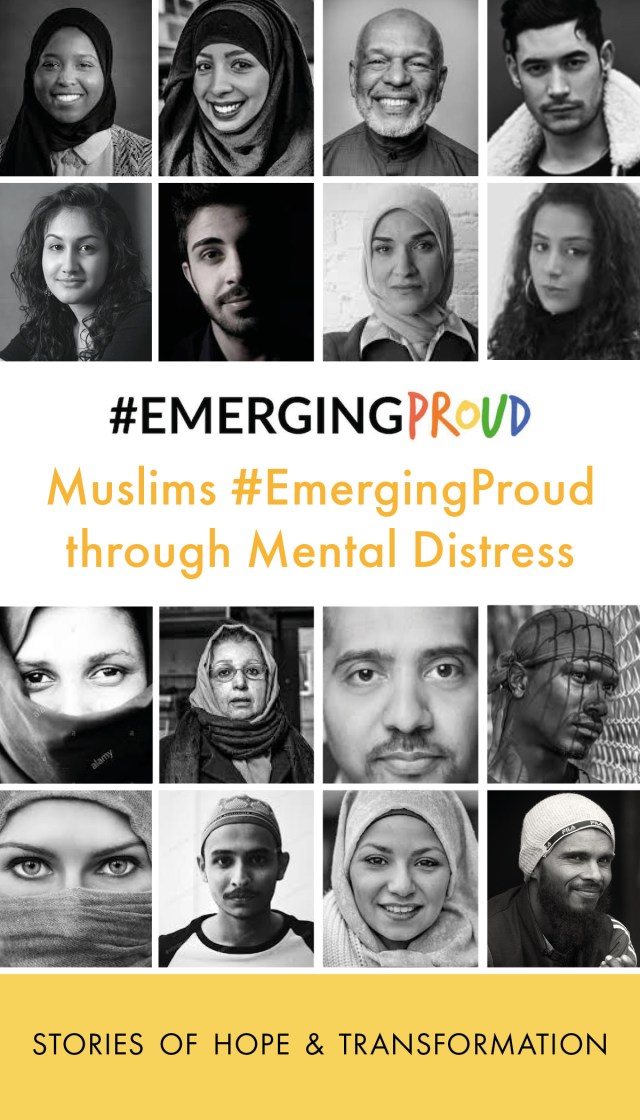
Muslims Emerging Proud cover v2

(Please note that these are not the faces which will appear on the final publication cover)

Follow this blog to keep updated about this book’s content and publication date.

WE WILL ANNOUNCE OUR FABULOUS REP FOR THIS BOOK HERE TOMORROW! 

Do you identify as a Muslim having been through emotional distress which has made you stronger? Would you like to join the other brave voices aiming to end this silent stigma and #Emerge Proud for your community and humanity united?

CONTACT US HERE to find out how to share your story


Posted in Uncategorized | Leave a comment

What happened on 17th Jan 2020? The outcomes report

We gathered and trusted in

connections2

This was the result.

On Friday 17th Jan we held an open space conference in London, UK to discuss the question; 

How does the Power Threat Meaning Framework relate to those who perceive their experience in transcendent/ transformative, spiritual or spiritual emergency terms, and how could it be used to support this?

The report below outlines the outcomes from these discussions, and highlights the commonalities and actions points raised, in order that they could be fed back to the Power Threat Meaning Framework team to be integrated into this new conceptual framework for mental health, where deemed appropriate.

17th Jan #Emerging Proud : PTMF event outcomes report

Posted in Uncategorized | Leave a comment